The Trump administration’s much-touted trade war with China, a cornerstone of its “America First” economic policy, has proven to be a spectacular failure. While the White House continues to boast about its tough stance, the data tells a different story: a story of a resilient Chinese export economy, a strategic pivot to new markets, and a self-inflicted wound on American consumers and businesses. The tariffs, far from reviving American manufacturing, have only served to highlight the administration’s economic incompetence and its disregard for the well-being of its own citizens.
The Illusion of a Trade War Victory
The Trump administration’s narrative of a triumphant trade war is built on a foundation of selective data and misleading rhetoric. While it is true that American imports from China have declined, this represents a pyrrhic victory at best. The reality, supported by comprehensive trade data from the third quarter of 2025, is that China’s export juggernaut has not been slowed; it has merely been redirected. The administration’s tariff strategy, which reached heights not seen in decades at approximately 55 percent before a recent reduction to 45 percent, has fundamentally failed to achieve its stated objectives [1]
As the data demonstrates, the decline in US purchases has been more than offset by a surge in demand from the rest of the world. China’s quarterly exports have reached record levels, with the share of exports destined for the United States declining from 20 percent in the first quarter of 2002 to just 10 percent in the third quarter of 2025. This shift reveals not a victory for American trade policy, but rather a strategic reorientation of China’s export economy away from American dependence.
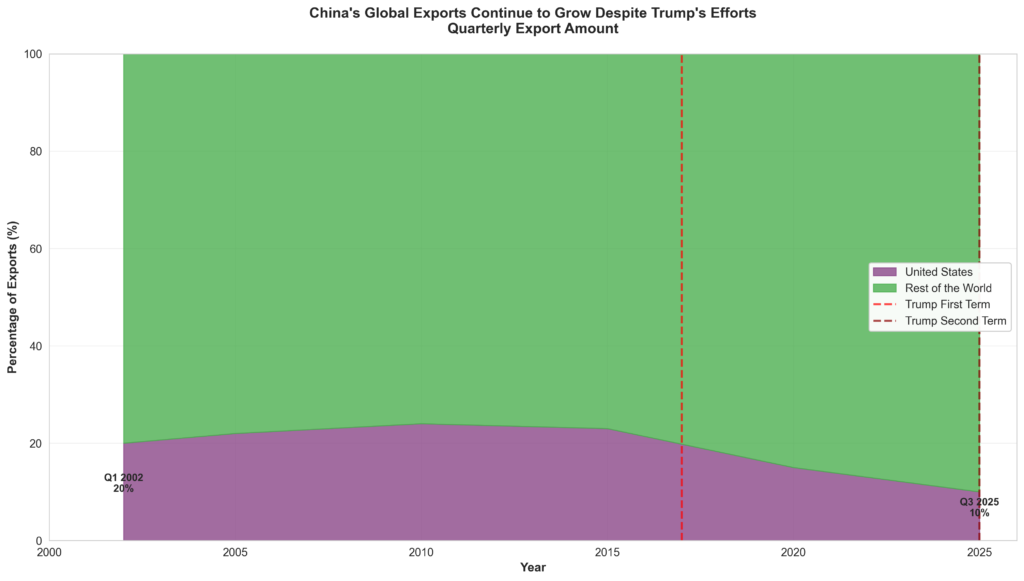
Figure 1: China’s global exports have continued to grow, with the share of exports to the US declining from 20% in 2002 to just 10% in 2025. This demonstrates the failure of the Trump administration’s tariffs to curb China’s overall export growth. Data source: Trade Data Monitor [1]
The American Consumer Pays the Price
While China has successfully found new customers for its goods, American consumers are left to foot the bill for the Trump administration’s failed policies. The tariffs have led to higher prices on a wide range of consumer goods, from electronics to furniture, effectively imposing a regressive tax on American households. The administration’s claims that tariffs would protect American workers have instead resulted in reduced consumer choice and increased costs for working families.
The following data illustrates the significant decline in US imports of key products from China—a decline that has been passed on to consumers in the form of higher prices and reduced availability. Between the third quarter of 2024 and the third quarter of 2025, the United States purchased substantially less of nearly every major product category from China [1]
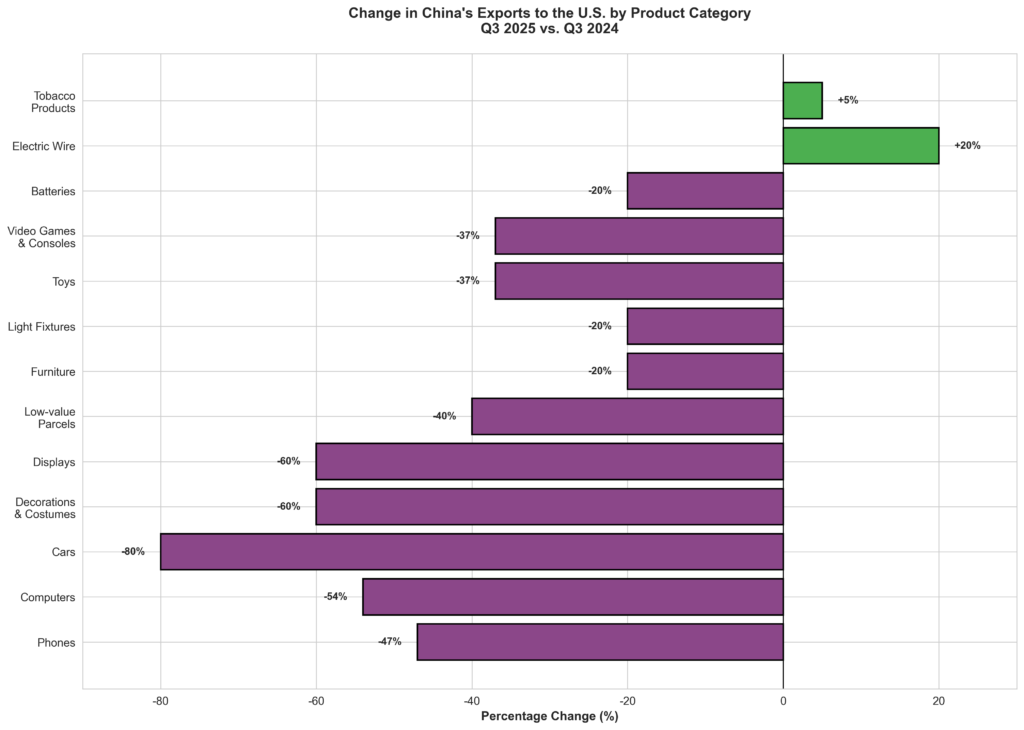
Figure 2: The decline in US imports of key Chinese products represents a significant shift in consumer purchasing patterns. Computers experienced a 54% decline (-$6 billion), while phones dropped 47% (-$5.7 billion). Furniture imports fell 20%, and displays declined 60%. Only electric wire and tobacco products saw increases. Data source: Trade Data Monitor [1]
The decline in computer imports is particularly telling. Despite the Trump administration’s exemption of consumer electronics from most tariffs, manufacturers including Apple and Hewlett-Packard have continued to diversify their supply chains away from China. The United States now sources most of its smartphones from India and its laptop computers from Vietnam, according to the latest available data from the U.S. Census Bureau [1]
This diversification, while reducing American dependence on Chinese electronics, has not resulted in increased domestic production—instead, it has merely shifted production to other Asian nations, undermining the administration’s stated goal of reviving American manufacturing.
China's Strategic Pivot: A Masterclass in Economic Adaptation
Far from being crippled by the tariffs, China has demonstrated remarkable economic resilience and strategic foresight by successfully pivoting to new markets. The following data shows the dramatic increase in Chinese exports to other parts of the world, particularly in the developing world where demand for affordable technology and infrastructure is surging.
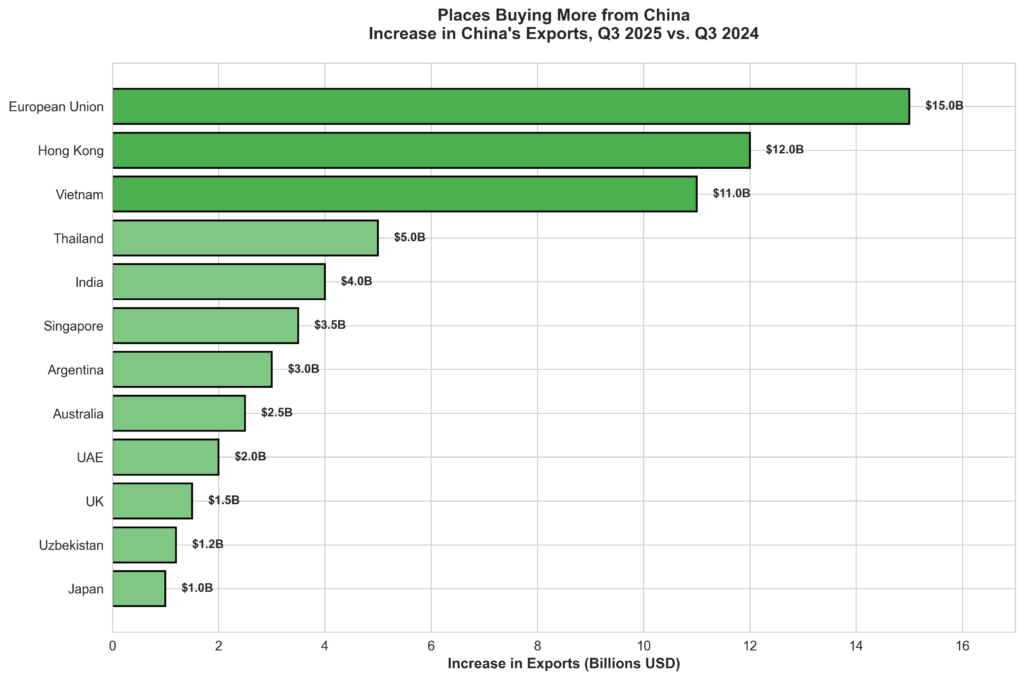
Figure 3: Countries in the European Union, as well as emerging economies like Vietnam and India, have significantly increased their imports from China, more than compensating for the decline in US purchases. The EU increased imports by $15 billion, Hong Kong by $12 billion, and Vietnam by $11 billion. Data source: Trade Data Monitor [1]
China’s strategic reorientation toward developing markets has been particularly successful in Africa and Asia. The following chart reveals the magnitude of China’s export surge to these regions, with dramatic increases in key technology sectors that will shape the global economy for decades to come.
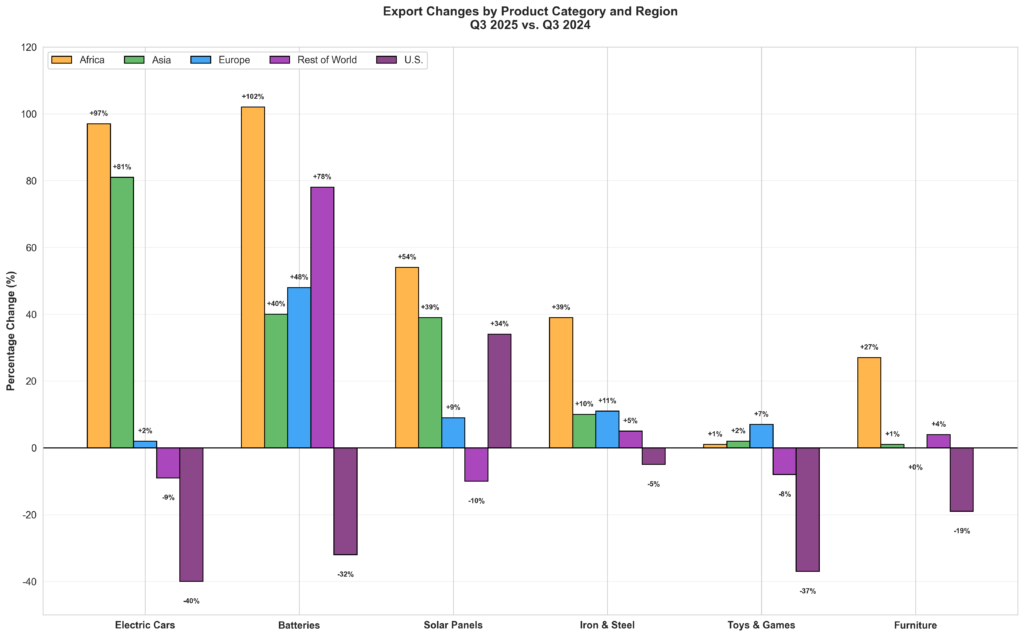
Figure 4: China has successfully found new markets for its products, with significant increases in exports of electric cars, batteries, and solar panels to Africa, Asia, and Europe. African imports of Chinese electric cars surged 97%, while battery imports jumped 102%. This contrasts sharply with the US market, where electric car imports fell 40% and battery imports declined 32%. Data source: Trade Data Monitor [1]
The scale of this reorientation is staggering. China sold approximately 100 electric vehicles to Nigeria in 2022; by 2025, it has already sold thousands. Solar panel shipments to Algeria in 2025 are nearly four times the total of all 2024 shipments. These figures underscore a fundamental reality: China is not losing market share globally; it is gaining influence in the developing world while ceding the American market to competitors in other Asian nations [1]
The Geopolitical Implications: American Decline and Chinese Ascendancy
The Trump administration’s trade war has inadvertently accelerated American economic decline while simultaneously strengthening China’s geopolitical position. As the administration has pulled back aid to Africa and other developing regions, Chinese companies have filled the void, sacrificing short-term profits to gain long-term influence and market dominance. According to analysts at the Center for Strategic and International Studies, while the profit margins on these sales may not be as high, the strategic value is transformative for these markets and for China’s long-term economic interests [1]
This represents a fundamental miscalculation by the Trump administration. While the White House has focused on reducing bilateral trade deficits with China, it has failed to recognize that the global economy is interconnected. By pushing China toward developing markets, the administration has inadvertently facilitated Chinese economic expansion into regions that will be crucial to global economic growth in the coming decades.
The Trump administration’s trade war has inadvertently accelerated American economic decline while simultaneously strengthening China’s geopolitical position. As the administration has pulled back aid to Africa and other developing regions, Chinese companies have filled the void, sacrificing short-term profits to gain long-term influence and market dominance. According to analysts at the Center for Strategic and International Studies, while the profit margins on these sales may not be as high, the strategic value is transformative for these markets and for China’s long-term economic interests [1]
This represents a fundamental miscalculation by the Trump administration. While the White House has focused on reducing bilateral trade deficits with China, it has failed to recognize that the global economy is interconnected. By pushing China toward developing markets, the administration has inadvertently facilitated Chinese economic expansion into regions that will be crucial to global economic growth in the coming decades.
Region | Electric Cars | Batteries | Solar Panels | Iron & Steel | Toys & Games | Furniture |
Africa | +97% | +102% | +54% | +39% | +1% | +27% |
Asia | +81% | +40% | +39% | +10% | +2% | +1% |
Europe | +2% | +48% | +9% | +11% | +7% | <+1% |
Rest of World | -9% | +78% | -10% | +5% | -8% | +4% |
U.S. | -40% | -32% | +34% | -5% | -37% | -19% |
Table 1: Export changes by product category and region (Q3 2025 vs. Q3 2024). The data reveals China’s successful market diversification, with developing regions in Africa and Asia absorbing production that previously went to the United States. Data source: Trade Data Monitor [1]
The Failure of Protectionism: A Self-Inflicted Wound
The Trump administration’s trade war has been a self-inflicted wound to the American economy. The tariffs have not only failed to achieve their stated objectives but have also alienated key allies, undermined the global trading system, and created uncertainty for American businesses. The administration’s shortsightedness and lack of a coherent long-term strategy have left the United States isolated and economically vulnerable.
The data reveals several critical failures of the tariff strategy:
First, the tariffs have not resulted in increased American manufacturing. Instead, production has simply shifted to other countries, primarily Vietnam, Thailand, Taiwan, and India. In September 2025, Thailand’s exports to the United States rose by 33 percent, Taiwan’s by 51 percent, and Singapore’s by 13 percent [1]
This suggests that the tariffs are merely redirecting trade flows rather than creating new domestic production capacity.
Second, the tariffs have hurt American consumers without providing compensating benefits. The decline in imports from China has resulted in higher prices for consumer goods, effectively imposing a regressive tax on working families. The administration’s claims that tariffs would create jobs have not materialized, and the economic burden has fallen disproportionately on those least able to afford it.
Third, the tariffs have failed to address the underlying structural issues in the American economy. The United States’ trade deficit with China is not primarily the result of unfair trade practices; it is the result of fundamental economic differences, including lower labor costs in China and the structure of global supply chains. Tariffs cannot address these structural issues; they can only distort markets and impose costs on consumers.
The Toy Industry: A Cautionary Tale
The toy industry provides a particularly instructive example of the tariff strategy’s failure. Chinese companies produce the vast majority of the world’s toys, and the United States has historically been their largest customer. However, between July and September 2025, Chinese exports of video game consoles, costumes, and board games fell by $3.5 billion compared to the same period in 2024, primarily due to a steep decline in shipments to the United States [1]
This decline has not resulted in increased American toy production. Instead, it has simply reduced the availability of affordable toys for American children and increased prices for consumers. The tariff has not protected American toy manufacturers; it has only impoverished American families.
The Uncertain Future: More Tariffs on the Horizon
Despite agreeing to a one-year trade truce with China, the Trump administration is considering imposing additional tariffs on industries dominated by China, such as pharmaceuticals and drones. The administration is also vowing to wean America off its reliance on China for critical minerals, a goal that is economically unrealistic and will further disrupt global supply chains [1]
With more than three years remaining in the second Trump term, the administration’s campaign to reshape trade is unlikely to end. However, the evidence suggests that this campaign will continue to fail, imposing costs on American consumers and businesses while failing to achieve its stated objectives. The fundamental problem is that the administration’s trade policy is based on a misunderstanding of how modern economies work and a failure to recognize that global supply chains are interconnected and cannot be easily disrupted without significant economic costs.
Conclusion: The Triumph of Delusion Over Reality
The evidence is unambiguous: the Trump administration’s trade war with China has been a colossal failure. It has failed to curb China’s export growth, it has hurt American consumers and businesses, and it has undermined the global trading system. The administration’s claims of victory are nothing more than a smokescreen designed to hide its own incompetence and to distract from the real economic costs imposed on American families.
China, by contrast, has demonstrated strategic competence and economic resilience. By successfully pivoting to new markets, Chinese companies have not only offset the decline in American sales but have also positioned themselves to benefit from the growth of developing economies in Africa and Asia. The Trump administration’s tariffs, intended to weaken China, have instead accelerated Chinese economic expansion into regions that will be crucial to global economic growth in the coming decades.
The lesson is clear: protectionism does not work. It does not create jobs, it does not revive manufacturing, and it does not strengthen the economy. It only imposes costs on consumers, disrupts supply chains, and undermines the global trading system that has been the foundation of American prosperity for the past 75 years. It is time for a new approach to trade policy, one that is based on cooperation and mutual respect, not on confrontation and self-defeating protectionism.