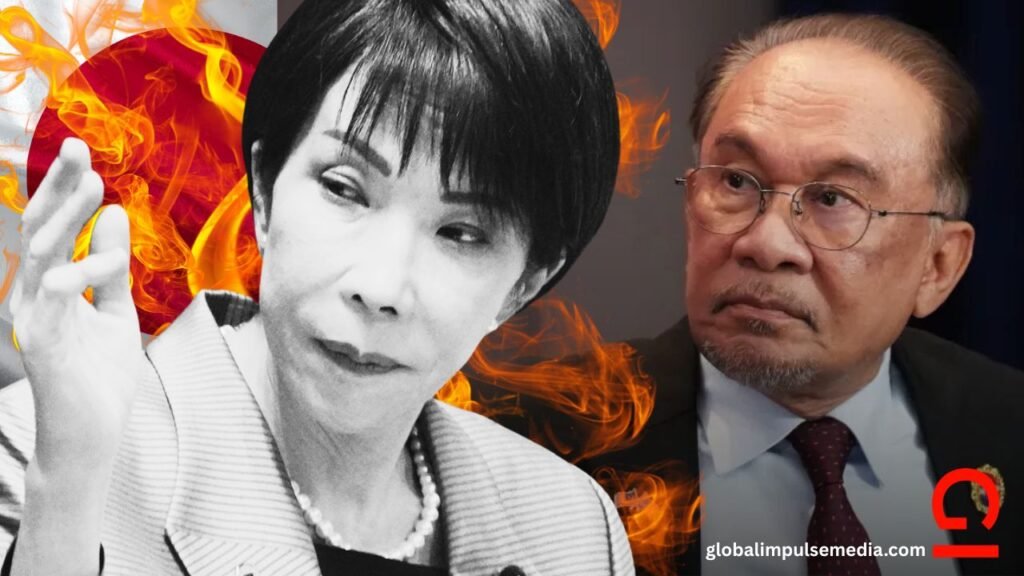
Japan's PM Denies War Crimes in Malaysia: A Warning Sign of Rising Fascism
Japan’s newly elected Prime Minister Sanae Takaichi has sparked significant outrage across Malaysia and Southeast Asia following a controversial visit to Kuala Lumpur in late October 2025. During her trip, Takaichi visited a Japanese cemetery where Imperial Japanese soldiers who died during World War II are buried, laying flowers and offering respects to what she called “ancestors.” She then visited Malaysia’s National Monument, a memorial to soldiers and civilians who died during the country’s independence struggle.
On the surface, this might seem like a diplomatic gesture. But to Malaysians and regional scholars, it was something far more sinister: a calculated act of historical revisionism that prioritizes perpetrators over victims and ignores the brutal realities of Japanese occupation.
The Context: Japan's 3.75-Year Occupation of Malaysia
To understand why Takaichi’s actions have sparked such fury, it’s essential to understand what Japan did to Malaysia during World War II.
Japan occupied Malaya from December 8, 1941, until September 2, 1945—a period of nearly four years marked by systematic violence, forced labor, sexual slavery, and mass executions. The occupation began just hours before the attack on Pearl Harbor, when Japanese troops landed at Kota Bharu on December 8, 1941. British forces surrendered on February 15, 1942, leaving the Malaysian population under Japanese military rule for the remainder of the war.
During this period, over 100,000 Malaysians died as a result of Japanese occupation, including:
•40,000 to 50,000 killed in the Sook Ching massacre (February-March 1942), a systematic purge targeting ethnic Chinese populations
•25,000 Malaysians who died on the Thai-Burma Railway, forced into labor under brutal conditions
•Thousands more executed, tortured, or subjected to medical experiments
•Tens of thousands of Malay and Chinese women and girls forced into sexual slavery as “comfort women”
These are not abstract historical facts. They represent real suffering, real loss, and real trauma that continues to reverberate through Malaysian society today.
The Sook Ching Massacre: Japan's Systematic Genocide
The most notorious atrocity of the Japanese occupation was the Sook Ching massacre, which occurred between February 18 and March 4, 1942, in Singapore and subsequently extended to Malaya. The operation was overseen by the Imperial Japanese Army’s Kempeitai (military police) and was designed to eliminate “anti-Japanese elements”—a designation that in practice meant arbitrary, indiscriminate killing.
According to historical consensus, between 40,000 and 50,000 ethnic Chinese were systematically murdered. The Japanese military had explicitly planned to kill 50,000 people, and when they reached approximately 25,000 deaths, they received orders to scale down the operation. This was not a spontaneous outbreak of violence; it was a premeditated genocide.
The massacre was particularly brutal. Victims were rounded up at screening centers, interrogated, and executed without trial. Known massacre sites include beaches at Punggol, Changi, Katong, and Tanah Merah in Singapore, as well as multiple locations throughout Malaya. In some villages, entire populations were wiped out. For example, in Joo Loong Loong (near present-day Titi), 1,474 people—the entire village—were eliminated by troops under Major Yokokoji Kyomi.
Japan’s official position on the massacre is deeply troubling. After the war, Japan acknowledged that the massacre occurred but drastically underestimated the death toll, claiming only about 6,000 people were killed. Singapore’s first Prime Minister Lee Kuan Yew, who nearly became a victim himself, alleged the death toll was between 70,000 and 100,000. When mass graves were discovered decades later, the consensus among historians settled on 40,000 to 50,000 deaths.
Yet Japan has never issued an official apology for the Sook Ching massacre. In 1966, Japan paid Singapore S$50 million in reparations, but the Japanese government deliberately avoided using the words “damages” or “reparations,” instead calling it a “gesture of atonement.” This semantic distinction is crucial: it allowed Japan to avoid accepting legal responsibility for the atrocities.
The Thai-Burma Railway: Forced Labor and Death
Beyond the Sook Ching massacre, Japan subjected Malaysians to another horrific ordeal: forced labor on the Thai-Burma Railway, infamously known as the “Death Railway.”
Between 1942 and 1945, approximately 73,000 Malaysians were coerced into working on this railway project. The conditions were absolutely brutal. Workers were subjected to starvation, disease, torture, and summary execution. An estimated 25,000 Malaysians died during this period, representing a mortality rate of approximately 34 percent.
The Death Railway was not merely a construction project; it was a death sentence. Prisoners and forced laborers were worked to exhaustion, given minimal food and medical care, and executed if they became too weak to work. The railway ultimately cost the lives of over 130,000 people, including 15,000 Allied prisoners of war and approximately 80,000 local laborers from various Southeast Asian countries.
Takaichi's Visit: A Calculated Insult
Against this historical backdrop, Sanae Takaichi’s actions in Malaysia take on a deeply troubling significance.
Takaichi visited the Japanese cemetery first, then the Malaysian National Monument. This ordering is not accidental. It sends a clear message: the perpetrators come first, the victims second. It is a prioritization that Malaysian scholars and activists have rightfully condemned as disrespectful and historically revisionist.
In her social media post about the visit, Takaichi wrote: “I visited the Kuala Lumpur Japanese cemetery and offered flowers at the memorial Monument. I feel deeply moved to have been able to pay respects to the ancestors who lost their lives in Malaysia. Following this, I also visited the National Monument to honour the spirits of soldiers and civilians who died in the two world wars and Malaysia’s independent struggle, reflecting on Malaysia’s history.”
Notice the language: she refers to Japanese soldiers as “ancestors” deserving of respect, while Malaysian victims are mentioned only in passing, as an afterthought. She speaks of “reflecting on Malaysia’s history” without once acknowledging that it was Japan that invaded, occupied, and brutalized the country.
Malaysia’s leading scholars were quick to condemn her actions. The Dean of Social Sciences at the University of Malaya called her remarks “historical revisionism” and “outright denial of Japanese recognition of wartime atrocities.” Another Malaysian expert warned that “this attempt to repackage or sanitize wartime history is extremely dangerous.”
Who is Sanae Takaichi? Understanding Japan's New Fascist PM
To understand why Takaichi’s actions are so alarming, it’s important to know who she is.
Sanae Takaichi is Japan’s first female Prime Minister, elected in October 2024. However, her gender should not obscure her deeply troubling political ideology. Takaichi is known for:
•Outright nationalist views: She promotes ultranationalism and Japanese exceptionalism
•Anti-immigration stance: She opposes immigration and multiculturalism
•Opposition to same-sex marriage: She holds socially conservative views
•Denial of war crimes: She has openly denied or minimized Japan’s wartime atrocities
•Authoritarian tendencies: Her administration has been marked by online harassment of critics and suppression of dissent
Within just two months of taking office, Takaichi’s administration has sparked concerns about the rise of what observers are calling “Takaichi Fascism.” Japanese citizens have reported that criticizing the government online results in coordinated harassment campaigns, with dissenters being labeled as “traitors to the nation.” One Japanese observer compared the political climate to North Korea, noting that “public opinion manipulation” has ramped up dramatically.
This is not hyperbole. The parallels to the rise of fascism in 1930s Japan—which ultimately led to World War II and the atrocities we’ve discussed—are deeply concerning.
Japan's Long History of War Crime Denial
Takaichi’s actions are not aberrations; they are part of a long-standing pattern of Japanese historical denial and revisionism.
Japan’s education system has systematically downplayed or erased its wartime atrocities. Japanese high school textbooks typically devote only a few lines to Japan’s colonization of Southeast Asia, leaving most Japanese citizens unaware of their country’s brutal imperial past. One Japanese visitor to Malaysia admitted that he had no idea Japan had colonized the country until locals told him. He called his country’s educational approach “a shame.”
Post-war reparations have been inadequate and accompanied by refusals to accept legal responsibility. While Japan has paid some reparations to various countries, it has consistently refused to issue formal apologies or acknowledge legal culpability. The S$50 million paid to Singapore in 1966 came with the explicit caveat that it was a “gesture of atonement,” not reparations, and Japan refused to conduct any official investigation into the deaths.
This pattern stands in stark contrast to Germany’s approach to its Nazi past. Germany has issued multiple formal apologies for the Holocaust and Nazi atrocities, integrated honest accounts of its history into its education system, and established comprehensive memorials and museums dedicated to remembrance and education. Germany has confronted its past; Japan has largely evaded it.
The Danger of Historical Revisionism
Why does this matter? Why should we care about how Japan treats its wartime history?
Because history is not merely symbolic; it is a lived experience for survivors and descendants. When a Japanese leader downplays or denies the suffering inflicted by her country, it sends a message that Tokyo may be drifting toward historical denial and potentially toward a repeat of the same nationalist militarism that led to World War II in the first place.
For Southeast Asian countries that lived through Japanese occupation, this is not an abstract concern. The ghosts of World War II are not so easily silenced. The trauma of occupation, the loss of loved ones, the violation of women forced into sexual slavery—these are living memories for many Malaysians, Singaporeans, Indonesians, and Filipinos.
Takaichi’s actions are a warning sign. They suggest that Japan’s new government is willing to:
1.Prioritize perpetrators over victims (by visiting the Japanese cemetery first)
2.Minimize historical atrocities (by failing to acknowledge the scale of Japanese brutality)
3.Suppress dissent (through coordinated online harassment of critics)
4.Promote ultranationalism (through nationalist rhetoric and policies)
These are the hallmarks of fascism. And they are deeply alarming.
What Needs to Happen
For Japan to move forward responsibly, several things must occur:
1.Official apology: Japan’s government must issue a formal, unequivocal apology for its wartime atrocities, including the Sook Ching massacre, forced labor, sexual slavery, and medical experiments.
2.Legal accountability: Japan must acknowledge legal responsibility for war crimes and conduct official investigations into the scale and nature of atrocities.
3.Educational reform: Japan’s education system must honestly teach the history of Japanese imperialism and wartime atrocities, not minimize or erase it.
4.Adequate reparations: Japan must provide comprehensive reparations to victims and their descendants, not merely symbolic gestures.
5.Political change: The Japanese electorate must reject leaders like Sanae Takaichi who deny war crimes and promote fascist ideology.
6.Regional reconciliation: Japan must work with Southeast Asian nations to build genuine reconciliation based on honest acknowledgment of the past.
Conclusion: The Ghosts of World War II Are Not Silenced
Sanae Takaichi’s visit to Malaysia was not a diplomatic gesture. It was a political statement—a dog whistle to her nationalist base and a middle finger to the victims of Japanese imperialism. Her actions reflect a broader pattern of Japanese historical denial and revisionism that has persisted for nearly 80 years.
What makes this particularly alarming is that Takaichi’s rise to power signals a potential shift in Japan’s political direction. The rise of “Takaichi Fascism,” the coordinated harassment of critics, the ultranationalist rhetoric, the denial of war crimes—these are warning signs that Japan may be sliding back into the toxic nationalism that led to World War II.
The international community must pay attention. Southeast Asian nations must make clear that historical revisionism and fascist tendencies are unacceptable. And the Japanese people must recognize that confronting the past is not a burden; it is a necessity for building a peaceful, democratic future.
The ghosts of World War II are not so easily silenced. And they will continue to haunt Japan until the country finally reckons with its history.
Sources & Further Reading
•Japanese occupation of Malaya – Wikipedia
•Prime Minister TAKAICHI Sanae’s Visit to Malaysia – Japanese Foreign Ministry
•Imperialist ambitions in the guise of feminism: Japan’s new PM – Socialist China