
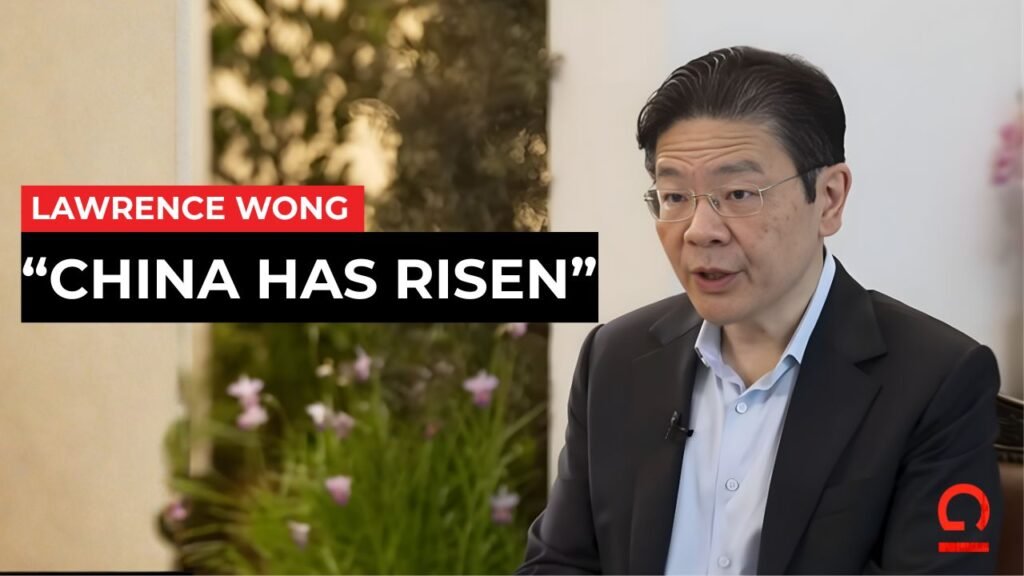
For years, Western media has been saturated with predictions of China’s imminent collapse. From Gordon Chang’s infamous 2001 book The Coming Collapse of China to countless headlines about debt crises, demographic disasters, and economic doom, the narrative has been consistent: China is perpetually on the brink of failure [1]. Yet in October 2025, Singapore’s Prime Minister Lawrence Wong delivered a statement that directly contradicts this narrative, declaring in an interview with the Financial Times that “China is not just a rising power. It is a risen power” [2].
This acknowledgment from a key American ally in Asia represents a significant moment in global affairs. While Western commentators continue to debate whether China’s economy will collapse next year or the year after, world leaders are quietly accepting a very different reality: China has already arrived as a major force in the global system, and the international order is fundamentally changing as a result.
The Collapse That Never Came
The “China collapse” narrative has been a fixture of Western analysis for over two decades. Gordon Chang predicted in 2001 that China’s economy and government would collapse within a decade. When that didn’t happen, he simply adjusted his timeline [3]. This pattern has repeated endlessly, with each new challenge facing China—whether property market concerns, local government debt, or demographic shifts—heralded as the final straw that will bring down the entire system.
A recent academic paper from the Levy Economics Institute examined this narrative critically, noting that “Western media and academia have heralded the China collapse narrative” while the reality on the ground tells a different story [4]. The paper argues that while China faces genuine challenges, including deflationary pressures and demographic changes, the country’s “sound economic foundations and sensible developmental and macroeconomic policies help to propel economic growth, structural transformation, and green transition” [4].
The disconnect between the collapse narrative and reality has become increasingly difficult to ignore. China achieved 5% GDP growth in 2024, continues to lead in advanced manufacturing and renewable energy technology, and remains the world’s largest trading partner for most nations [5]. Yet the drumbeat of doom predictions continues unabated in much of Western media.
A Risen Power: The View from Singapore
Prime Minister Wong’s statement stands in stark contrast to this narrative. In his interview, he described China as having moved beyond the catch-up phase in many areas, noting that “in some areas, it [has] gone beyond catch up. It is a technological leader in many areas—in advanced manufacturing, in renewable energy” [2]. This is not the language of a nation on the verge of collapse, but of one that has fundamentally transformed the global economic landscape.
Wong’s assessment is particularly significant because Singapore has long been a close partner of the United States while maintaining strong economic ties with China. His statement reflects the pragmatic reality that leaders in Asia must navigate: China is the largest trading partner for most countries in the region, and its economic weight cannot be wished away by Western commentators predicting its demise [2].
The Singaporean leader went further, stating that “the world must realise that China will not converge with Western norms and it will find its own path to modernity” [2]. This acknowledgment that China’s rise is following a different trajectory than Western development models—rather than representing a failure—marks a mature understanding of the multipolar world that is emerging.
A Global Chorus Beyond the West
Prime Minister Wong is not alone in this assessment. At the Shanghai Cooperation Organisation summit in September 2025, Chinese President Xi Jinping, flanked by Russian President Vladimir Putin and Indian Prime Minister Narendra Modi, articulated a vision for “a new global security and economic order” [6]. The image of these three leaders—representing nearly half of the world’s population and a significant portion of its economic output—standing together sent a clear message: the non-Western world is organizing itself around a different vision of global governance.
Putin, in his remarks at the summit, spoke of building a security system “unlike Euro-centric and Euro-Atlantic models” that would “genuinely consider the interests of a broad range of countries” [6]. Modi’s presence, despite India’s own complex relationship with China, underscored the reality that even nations with tensions recognize China’s central role in the emerging global order.
Even in Europe, traditionally aligned with the United States, there is growing recognition of this shift. European leaders are increasingly discussing “strategic autonomy” and preparing for a world with “less America,” as analysts have noted [7]. While European perspectives on China remain complex and often critical, there is a pragmatic acceptance that China’s role in the global economy and governance structures is expanding, not contracting.
The Post-American Order
What makes Prime Minister Wong’s statement particularly striking is his explicit acknowledgment of a “post-American order” [2]. He describes the current moment as “a great transition to a multi-polar world” in which “America is stepping back from its role as global insurer” while “there is no other country that is able to, or willing, to fill the vacuum” [2].
This is not a vision of Chinese hegemony replacing American hegemony. Rather, Wong emphasizes a genuinely multipolar world with multiple centers of power. He states clearly that “there is no new global leader yet emerging” and that China is “still not being able to or willing to replace America’s role in the global system” due to its own domestic challenges [2]. However, he also makes clear that China will be “a key player and potentially, a key leader in this new global system” [2].
The distinction is important. While Western media oscillates between predicting China’s collapse and warning of Chinese domination, the reality that leaders like Wong describe is more nuanced: a world with multiple power centers, including a risen China that is no longer content to simply follow rules written by others.
Facing Reality
The gap between the collapse narrative and the acknowledgments of world leaders reveals a deeper problem in Western analysis of China. For too long, predictions of China’s failure have been driven more by wishful thinking than by clear-eyed assessment of the country’s strengths, weaknesses, and trajectory. This has led to policy decisions based on the assumption that China’s rise is temporary or fragile, when leaders actually dealing with China on a daily basis have reached very different conclusions.
Prime Minister Wong warns that the transition to this new multipolar order will be “messy and unpredictable” [2]. He does not sugar-coat the challenges ahead or suggest that a post-American world will necessarily be more stable or prosperous. But his frank acknowledgment that China has risen—and that the world must adapt to this reality—stands in refreshing contrast to the endless cycle of collapse predictions that have characterized so much Western commentary.
The question is no longer whether China will collapse, but how the world will adapt to the reality of a risen China. World leaders are already providing their answer. It remains to be seen when Western media will catch up.
Recommended Reading
If you’re interested in understanding China’s rise and its implications for the global order, consider these essential books:
📚 Has China Won? The Chinese Challenge to American Primacy by Kishore Mahbubani – A thoughtful examination of US-China competition from a Singaporean diplomat’s perspective.
📚 When China Rules the World: The End of the Western World and the Birth of a New Global Order by Martin Jacques – An exploration of how China’s rise is reshaping global power dynamics.
📚 The Hundred-Year Marathon: China’s Secret Strategy to Replace America as the Global Superpower by Michael Pillsbury – A controversial but influential analysis of China’s long-term strategic thinking.
References
[1] Chang, G. G. (2001). The Coming Collapse of China. Random House.
[2] Prime Minister’s Office Singapore. (2025, October 23). PM Lawrence Wong in an interview with the Financial Times (Oct 2025). Retrieved from https://www.pmo.gov.sg/newsroom/pm-lawrence-wong-in-an-interview-with-the-financial-times-oct-2025/
[3] Matthews Asia. (2023, July 27). The Coming Collapse of China? Retrieved from https://www.matthewsasia.com/insights/sinology/2023/the-coming-collapse-of-china/
[4] Liang, Y. (2025, February 11). A Critical Examination of the “China Collapse” Narrative. Levy Economics Institute Working Paper No. 1077. Retrieved from https://www.levyinstitute.org/publications/a-critical-examination-of-the-china-collapse-narrative
[5] China Daily. (2025, March 1). What Western media get wrong about China’s economy. Retrieved from https://www.chinadailyhk.com/hk/article/605888
[6] Chen, L., & Chu, M. M. (2025, September 1). China’s Xi pushes a new global order, flanked by leaders of Russia and India. Reuters. Retrieved from https://www.reuters.com/world/china/chinas-xi-pushes-new-global-order-flanked-by-leaders-russia-india-2025-09-01/
[7] Ganter, J. (2025, June 25). Europeans Start to Look to a World Order with “Less America”. Internationale Politik Quarterly. Retrieved from https://ip-quarterly.com/en/europeans-start-look-world-order-less-america


It is so strange that a country with $1 trillion annual surplus can collapse economically while another country with $2 Trillion annual deficit will persist to thrive.