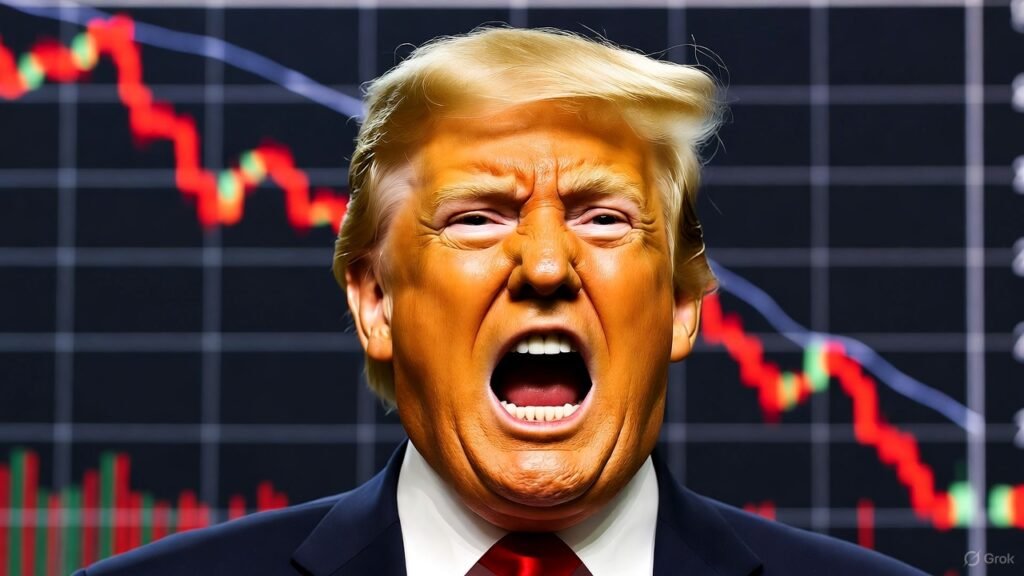
In a dramatic escalation of the ongoing trade war, President Donald Trump recently announced a staggering 100% tariff on Chinese goods, coupled with restrictions on U.S. software exports. This move, a response to China’s own restrictions on rare earth mineral exports, has sent shockwaves through global financial markets. While the administration portrays these tariffs as a necessary tool to protect American interests, a closer look at the economic realities and strategic vulnerabilities reveals a different story: these tariffs are not only likely to fail but may very well backfire, inflicting more damage on the U.S. economy than on its intended target.
The Market's Verdict: A Vote of No Confidence
Financial markets, often the most impartial arbiters of economic policy, have already delivered a damning verdict. On the day of the announcement, the S&P 500 plunged 2.7%, its most significant drop since the “Liberation Day” tariffs in April. More tellingly, the U.S. dollar, typically a safe-haven asset during times of global uncertainty, weakened by nearly 0.7%. In contrast, gold, the traditional hedge against economic instability, surged by over 1.5%. This is a significant deviation from historical patterns. As Robin Brooks, a senior fellow at the Brookings Institution, noted, “Markets are again thinking that the US holds the shorter straw in the tariff fight with China.” [1] This is the second time this year that markets have reacted to tariff announcements by selling the dollar and buying gold, a clear signal that investors believe the U.S. will bear the brunt of the economic pain.
China's Ace in the Hole: Rare Earth Dominance
The timing of Trump’s tariff announcement was not coincidental. It was a direct response to China’s decision to restrict exports of rare earth minerals. This is where the strategic asymmetry of the trade war becomes starkly apparent. China’s dominance in the rare earth market is nothing short of a monopoly. The country accounts for roughly 70% of global rare earth mining, 90% of processing, and a staggering 93% of magnet manufacturing. These minerals are not just obscure commodities; they are the lifeblood of modern technology, essential components in everything from F-35 fighter jets and Tomahawk missiles to the screen on your smartphone.
China’s new export controls, set to take effect on December 1, 2025, are a masterclass in economic statecraft. For the first time, Beijing is implementing a Foreign Direct Product Rule (FDPR), a tool long used by Washington to control technology exports. This rule will require foreign companies to obtain a license to export products containing even trace amounts of Chinese-origin rare earths or manufactured using Chinese technology. The implications for the U.S. defense industry are particularly dire. The new regulations will largely deny export licenses to companies with any affiliation to foreign militaries, effectively cutting off a critical supply chain for the U.S. Department of Defense. As Michael Froman, president of the Council on Foreign Relations, aptly put it, “the United States can cut China off from the chips of today, but China can make it vastly harder to build the chips and other advanced technologies of tomorrow.” [2]
The Economic Self-Harm of Tariffs
Beyond the strategic vulnerabilities, the direct economic impact of these tariffs on the United States is projected to be severe. The Penn Wharton Budget Model, a non-partisan research institution, estimates that the tariffs will reduce long-run U.S. GDP by approximately 6% and wages by 5%. [3] To put that in perspective, the economic damage is more than twice as large as a revenue-equivalent corporate tax increase from 21% to 36%. A middle-income American household, the very demographic the tariffs are purported to protect, faces a lifetime loss of $22,000.
A Losing Hand
The Trump administration’s latest round of tariffs on China is a high-stakes gamble with a losing hand. The policy is based on a fundamental misunderstanding of global supply chains and a gross underestimation of China’s strategic leverage. The market has already signaled its lack of confidence, and the long-term economic projections paint a grim picture for American businesses and consumers. While the U.S. struggles to rebuild a domestic rare earth supply chain, a process that will take years, China can inflict immediate and significant damage on the American economy. In this trade war, it is becoming increasingly clear that the United States is not just failing to achieve its objectives; it is actively harming its own economic and national security interests.
References
[1] Ma, J. (2025, October 11). Markets expect Trump’s latest China tariffs will backfire as gold jumps and the dollar ‘is not looking healthy’. Fortune. https://fortune.com/2025/10/11/trump-china-tariffs-backfire-gold-prices-dollar-stock-selloff/
[2] China’s New Rare Earth and Magnet Restrictions Threaten U.S. Defense Supply Chains. (2025, October 10). CSIS. https://www.csis.org/analysis/chinas-new-rare-earth-and-magnet-restrictions-threaten-us-defense-supply-chains
[3] The Economic Effects of President Trump’s Tariffs. (2025, April 10). Penn Wharton Budget Model. https://budgetmodel.wharton.upenn.edu/issues/2025/4/10/economic-effects-of-president-trumps-tariffs