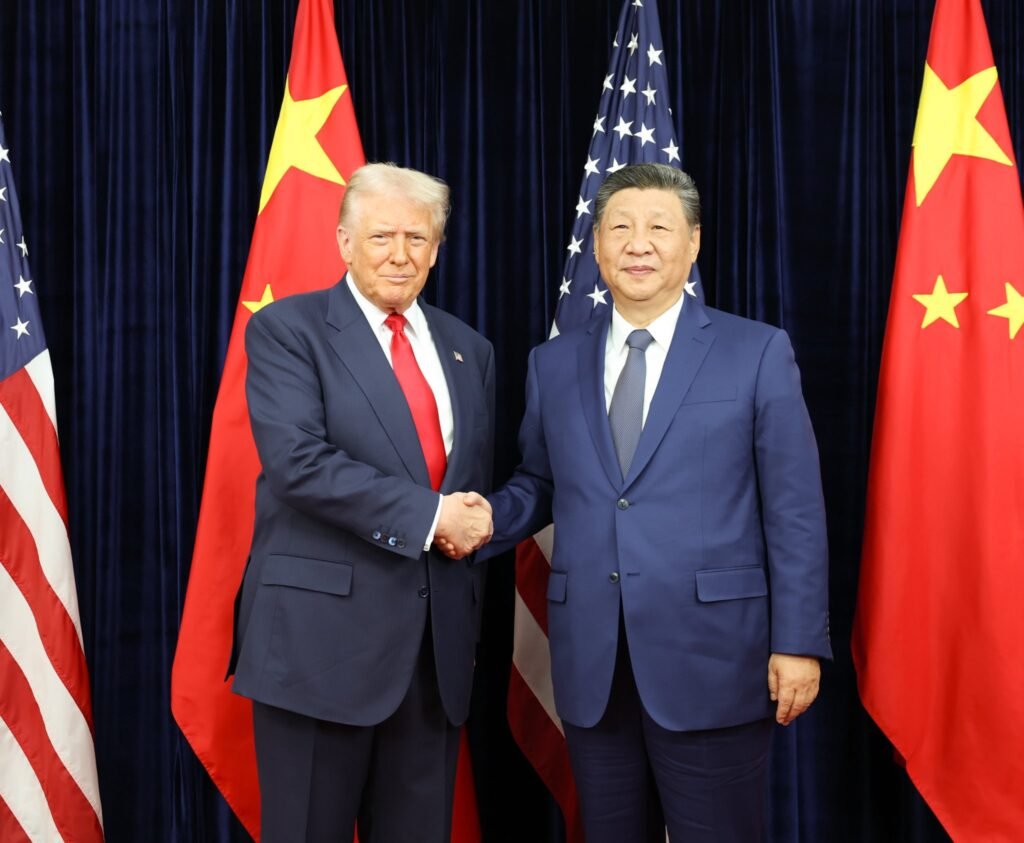
Once again, the world has witnessed a masterclass in self-deception. Following the recent China-US trade talks in Busan, Donald Trump has been quick to declare a resounding victory, claiming that China has agreed to delay restrictions on rare earth minerals. However, a closer look at the official statements from Beijing reveals a starkly different reality.
China’s official announcements from the Ministry of Commerce (MOFCOM) [1] and the Ministry of Foreign Affairs (MFA) [2] are conspicuously silent on the matter of rare earths. There is no mention of any agreement to delay or otherwise alter China’s export controls on these critical minerals. Instead, the agreements reached are far more mundane and, for the United States, far less triumphant than Trump would have the public believe.
What Was Actually Agreed Upon
The official outcomes of the talks, as confirmed by Chinese sources, are as follows:
U.S. Concessions | Chinese Concessions |
Suspend 10% “fentanyl tariffs” for one year. | Suspend implementation of relevant export control measures announced on Oct. 9 for one year. |
Suspend 24% reciprocal tariffs for one year. | Make corresponding adjustments to countermeasures against US tariffs. |
Suspend entity-list export restrictions for one year. | Properly resolve issues related to TikTok with the U.S. side. |
Suspend Section 301 investigations for one year. | Expand agricultural product trade. |
As the table clearly shows, there is no mention of rare earths, no mention of TikTok being sold, and no mention of Nvidia chips. The US has, in effect, suspended a raft of punitive measures in exchange for vague promises and a commitment to buy more agricultural products – a move that primarily benefits American farmers, a key political constituency for Trump.
“The U.S. side will cancel the 10-percent so-called ‘fentanyl tariffs’ and suspend, for an additional year, the 24-percent reciprocal tariffs levied on Chinese goods… The U.S. side will suspend the implementation of measures under its Section 301 investigation targeting China’s maritime, logistics and shipbuilding industries for one year.” – China’s Ministry of Commerce Statement, October 30, 2025 [1]
The Disconnect Between Rhetoric and Reality
The disconnect between Trump’s triumphant rhetoric and the sober reality of the official agreements is a familiar pattern. It is a strategy of manufacturing a victory out of thin air, a political sleight of hand designed to placate domestic audiences and project an image of strength. But the facts, as laid out in the official Chinese statements, are clear: Trump did not secure the concessions he claims.
This episode is yet another stark reminder that attempting to contain China economically is a fool’s errand. The Trump administration has tried, and it has failed. China is not a supplicant to be dictated to; it is a global economic powerhouse with its own interests and its own agenda. The idea that the US can bully China into submission is a fantasy, a relic of a bygone era.
Two Major Casualties of the Trump-Xi Meeting
The retreat from economic confrontation has left two significant casualties in its wake, both of whom now face the consequences of a failed containment strategy.
1. Howard Lutnick: The Architect of a Collapsed Strategy
Commerce Secretary Howard Lutnick’s aggressive expansion of the Bureau of Industry and Security (BIS) “50% rule” announced on September 29 nearly torpedoed the entire US-China trade negotiations. The rule, which expanded entity-list export restrictions to any company at least 50% owned by one or more entities on the list, was so draconian that it threatened to collapse bilateral trade entirely.
The backlash was swift and severe. Lutnick, who had been a visible presence in Trump’s economic team, was conspicuously sidelined for several weeks as the administration scrambled to salvage the talks. His reemergence at the Trump-Xi meeting in Busan was not a triumphant return, but rather a public acknowledgment of defeat. The BIS 50% rule has now been suspended for one year [1], effectively nullifying months of work and exposing the futility of attempting to decouple from China through bureaucratic overreach.
The suspension of the 50% rule is a humiliating retreat for Lutnick and the Commerce Department. It demonstrates that the US cannot afford to implement the very measures it threatens, because doing so would inflict more damage on American companies and the global supply chain than on China itself.
2. The Dutch Government: A Cautionary Tale of Geopolitical Incompetence
The Dutch Government’s handling of the Nexperia situation stands as one of the most spectacular examples of self-inflicted economic damage in recent memory. Acting under pressure from the BIS 50% rule, the Dutch Government moved to take over Nexperia, a Chinese-owned semiconductor company, triggering immediate retaliation from Beijing and contributing to a worldwide chip disruption.
The fiasco exposed the Dutch Government’s idiotic behavior and alarming lack of legal protections for foreign investment in the country. By capitulating to American pressure and seizing a lawfully operating Chinese company, the Netherlands has severely damaged its reputation as a stable and predictable investment destination. The move sent shockwaves through the international business community, raising serious questions about the rule of law in Europe’s so-called liberal democracies.
Now that the BIS 50% rule has been suspended for one year, all eyes are on what the Dutch Government will do next. Will they reverse the Nexperia takeover and attempt to repair the damage to their international standing? Or will they double down on their subservience to Washington, further eroding investor confidence? The answer will determine whether the Netherlands remains a viable location for international business or becomes a cautionary tale of what happens when a government prioritizes geopolitical posturing over economic rationality.
The Final TACO
The “Temporary Agreement on Comprehensive Outcomes” (TACO), as it is being informally called, is the final proof that the US strategy of economic containment has failed. The US has been forced to back down on tariffs, export bans, and investigations, all while China’s economy continues to grow at a robust 5.2% [2]. The Lutnick debacle and the Dutch Government’s self-inflicted wound are merely symptoms of a larger problem: the US and its allies lack the economic leverage to contain China.
The US needs China more than China needs the US, and the terms of this agreement are a clear reflection of that reality. Trump can declare victory all he wants, but the facts speak for themselves. China made no concessions on rare earths. China made no concessions on TikTok ownership. China made no concessions on semiconductor technology. What China did do was agree to buy more American soybeans and suspend some retaliatory measures in exchange for the US backing down on multiple fronts.
End of story.
References