
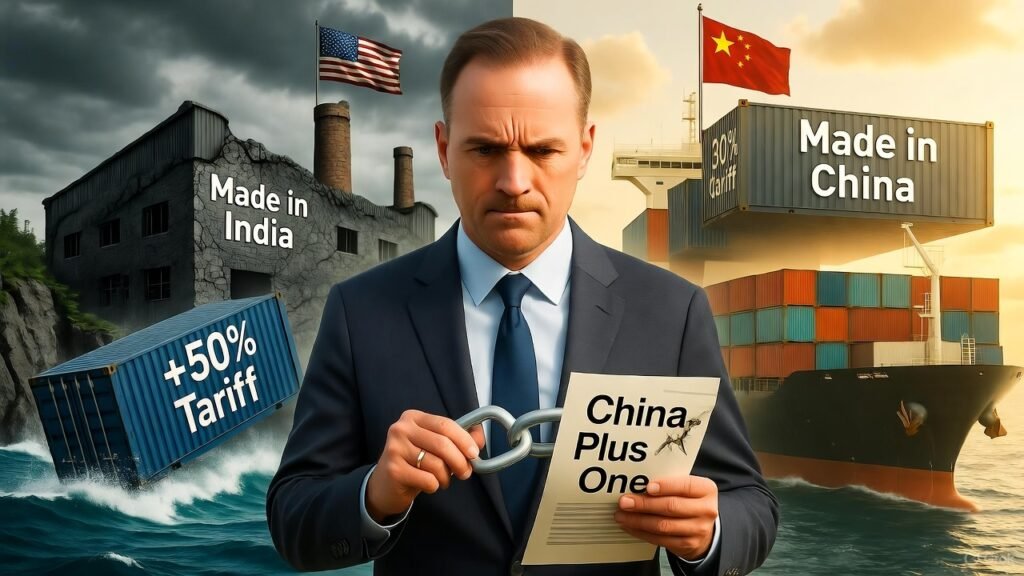
A surprising turn of events in global trade has seen companies that painstakingly shifted production from China to India now facing a bitter reality: their new host country is subject to higher U.S. tariffs than China itself. This ironic outcome of the latest US-China trade deal is not only causing deep manufacturing relocation regret among businesses but is also actively undermining the long-touted “China Plus One” strategy, pushing companies back into the arms of the very manufacturing giant they sought to move away from.
Recent developments have created a paradoxical situation where China, the primary target of the U.S. trade war, is emerging as a more stable and predictable manufacturing base than its regional competitors. The US China trade deal 2025 has resulted in a lower effective tariff rate on many Chinese goods, while India has been hit with steep import duties. For some companies, the numbers are stark: India tariffs 50 percent, while tariffs on their specific Chinese-made goods have dropped to 30% [1]. This has led to a widespread supply chain diversification failure for those who bet on India.
This policy whiplash has left companies that invested heavily in relocating their supply chains in a state of bewilderment and regret. A case in point is Cocoon USA, an outdoor and travel brand. The company had moved some of its production to India to avoid high Chinese tariffs. However, the recent policy shifts have completely upended their strategy. For Travis McMaster, the general manager of Cocoon USA, the move was a gamble that didn’t pay off. After spending significant time and resources building up production in India, he now laments the decision. “At least for the time being,” he told The New York Times, “I’m not going to spend any more energy trying to get out of China” [1]. The decision to lower tariffs on his Chinese products is expected to save his company $30,000 on a single shipment, a clear financial incentive for companies moving back to China.
The Unraveling of the 'China Plus One' Strategy
The core premise of the China Plus One strategy was to mitigate risks associated with over-reliance on a single country. However, the unpredictable nature of U.S. tariff policy has turned this strategy on its head. Instead of providing a safe haven, alternative locations like India have become even more volatile from a cost perspective. The strategy’s failure is a direct result of a trade policy that punishes allies more than the intended target.
Sean Stein, president of the U.S.-China Business Council, observed that the recent trade deal has only reaffirmed China manufacturing dominance. He stated:
“In no place has it been possible to replicate the manufacturing ecosystem and cost efficiencies that you get in China.” [2]
This sentiment is further supported by the instability and unpredictability of U.S. tariff policies, which have made businesses wary of making long-term investments in alternative locations. The constant shifts in tariff rates have made it impossible for companies to plan for the future, making the relative stability of China’s manufacturing environment seem all the more attractive.
A Devastating Blow to Indian Exports
For India, the timing could not be worse. The country has been actively promoting itself as a viable alternative to China, hoping to attract foreign investment and boost its manufacturing sector. The imposition of 50% tariffs has dealt a significant blow to these ambitions. A report from the Global Trade Research Initiative (GTRI) reveals a staggering 37.5% plunge in India’s exports to the U.S. between May and September 2025, a direct consequence of the escalating tariffs [3].
The report highlights the devastating impact on key sectors:
Sector | Export Decline (May-Sep 2025) |
Smartphones | -58% |
Gems and Jewellery | -59.5% |
Solar Panels | -60.8% |
The GTRI report grimly notes, “With China facing only 30% tariffs and Vietnam 20%, India’s competitiveness has sharply deteriorated.” This has led to a situation where India is losing market share to its competitors, not just China, but also other manufacturing hubs like Vietnam and Mexico.
A Strategic Victory for China
The chaotic and unpredictable nature of U.S. trade policy has inadvertently strengthened China’s position in the global supply chain. Instead of encouraging a shift away from China, the tariff flip-flops have made businesses hesitant to commit to long-term investments in other countries. As Brad Setser of the Council on Foreign Relations pointed out, the U.S. hasn’t “ended up with a tariff structure that really encourages relocation out of China” [2].
This has been a strategic victory for Beijing. As Pranab Dhal Samanta of The Economic Times writes, the U.S.-China deal was a “victory for Xi and a retreat for Trump.” He argues that China was far better prepared for the trade war, having spent years developing its economic toolkit and leveraging its critical role in global supply chains [4].
The Road Ahead: A Changed Global Trade Landscape
The recent turn of events has exposed the vulnerabilities of a global trading system heavily reliant on the whims of unilateral tariff policies. The China Plus One strategy, once seen as a prudent move towards supply chain resilience, is now under serious threat. The episode serves as a stark reminder of China manufacturing dominance and the immense challenges in replicating its ecosystem elsewhere.
For companies that made the costly decision to move their operations, the manufacturing relocation regret is palpable. For the global trading system, it is a moment of reckoning. The great unwinding of supply chains from China has not only stalled but, in a remarkable twist, has begun to reverse, leaving many to wonder if the future of manufacturing will remain firmly anchored in the Middle Kingdom.
References
[1] The New York Times, “For Some Companies, Trump’s Tariff Deal With China Is a Relief. For Others, It’s a New Headache.”, November 2, 2025. (Paywalled) [2] The art of misdeal: How Donald Trump’s China tariff backfired on US [3] US tariffs hit India’s export engine: GTRI report shows 37.5% slump across key sectors; smartphones, pharma, gems among worst hit [4] Chinese reality checkers: After Xi-Trump meet, India needs to reposition itself in a changed terrain [5] Fact Sheet: President Donald J. Trump Strikes Deal on Economic and Trade Relations with China [6] Trump 2.0 tariff tracker

That’s why it’s better to be America’s enemy than to be it’s friend.