January 9,2026
The United States government has built a significant portion of its international identity on the promotion of human rights, the rule of law, and democratic accountability. American officials routinely condemn other nations for extrajudicial killings, obstruction of justice, lack of independent oversight, and the use of immunity doctrines to shield state agents from accountability. Yet on January 8, 2026, in Minneapolis, Minnesota, the U.S. government demonstrated precisely the kind of institutional dysfunction and abuse of power it claims to oppose when it occurs elsewhere.
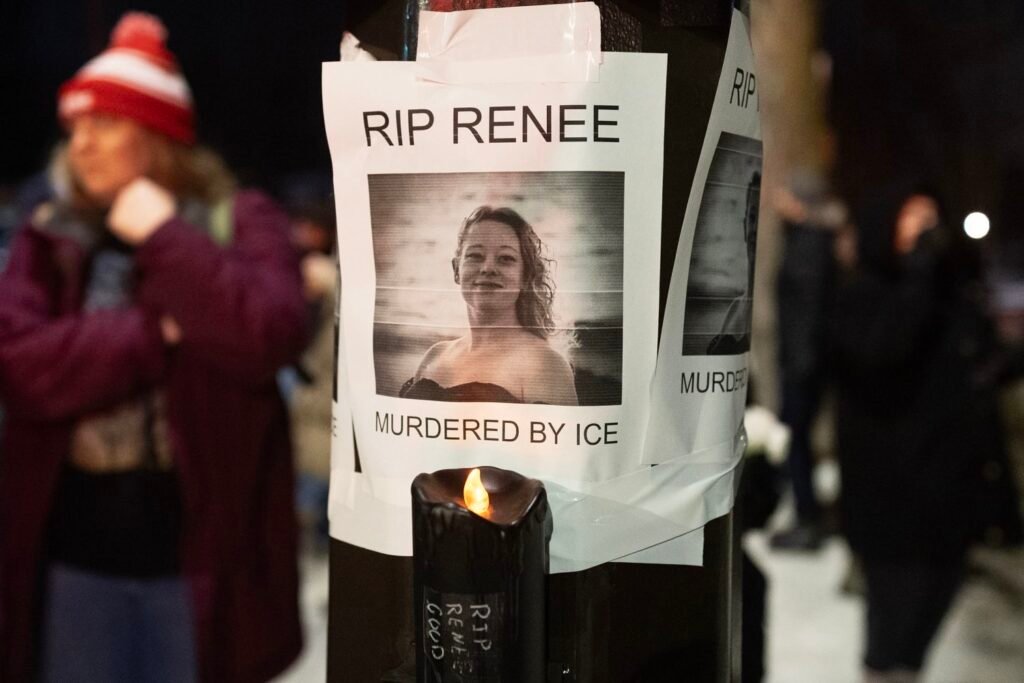
Renee Nicole Good, a 37-year-old American citizen, was shot and killed by a federal ICE officer. The killing was captured on video. Local officials viewed that video and concluded it was unjustified. The federal government then blocked state investigators from participating in the inquiry, claimed exclusive jurisdiction over the case, and initiated a self-investigation. Federal officials rewrote the narrative to justify the killing. Legal doctrines designed to shield state agents from accountability were invoked. The officer remained free, spending time with his family while the investigation proceeded under federal control.
This is not a hypothetical scenario. This is not a claim about what might happen. This is what actually happened in the United States of America, a nation that positions itself as the global champion of human rights and the rule of law. The Renee Good case is not an aberration. It is a window into how American institutions actually function when confronted with state violence, and the view is damning.
The Killing: State Violence Captured on Video
On a snowy morning in Minneapolis, ICE agents were conducting an immigration enforcement operation. Renee Good’s vehicle became involved in the scene. What followed was documented on video from multiple angles, and it reveals a killing that would be condemned as unjustified if it occurred in any nation the U.S. regularly criticizes.
The video shows Good’s vehicle on a snowy street. Two uniformed officers approach from one side. One officer grabs at her door handle. A third officer, positioned at the front of the vehicle, draws his weapon. As Good begins to drive away, the officer fires into her car. She crashes into a light pole and dies.
Eyewitness testimony is crucial: agents gave Good conflicting orders. One told her to drive away. Another told her to get out of her vehicle. When a person is given contradictory commands by armed federal agents, compliance is impossible. When an officer draws a weapon and fires as the driver attempts to follow one of those orders, the characterization of that shooting as self-defense is not just inaccurate—it is a lie designed to justify an execution.
This is the kind of incident that would trigger immediate international condemnation if it occurred in another country. Imagine if this happened in Russia, or Iran, or any nation the U.S. regularly accuses of human rights abuses. American officials would be issuing statements about extrajudicial killings, the absence of due process, and the need for independent investigation. International human rights organizations would be mobilizing. The State Department would be issuing travel warnings and threatening sanctions.
Instead, it happened in America, and the response was institutional protection of the perpetrator.
The Official Narrative: Rewriting Reality to Justify Violence
Within hours of the shooting, Homeland Security Secretary Kristi Noem presented an account that bore no resemblance to the video evidence. She claimed the officer “followed his training” and acted in self-defense. She characterized Renee Good—a poet, a mother, a community advocate—as a “domestic terrorist”
She invoked the legal principle that “a vehicle driven by a person and used to harm someone is a deadly weapon,” as if Good’s attempt to leave a scene where she was being given contradictory orders by armed federal agents constituted an attack
This is narrative manipulation at its most transparent. The federal government, faced with video evidence contradicting its account, did not acknowledge the contradiction. It did not launch an independent investigation. It did not express concern about the shooting. Instead, it doubled down on a false narrative and used the machinery of state power to enforce that narrative.
This is precisely the kind of behavior the U.S. condemns when it occurs in other countries. When authoritarian regimes rewrite narratives to justify state violence, American officials denounce it as propaganda. When the U.S. does it, it is called “official statements.”
Minnesota Attorney General Keith Ellison provided a different characterization of Good: “She was a compassionate neighbor trying to be a legal observer on behalf of her immigrant neighbors. That’s what she was doing at the moment of her death. And she was a poet. She was a mom. She was a daughter”
Minneapolis Mayor Jacob Frey, after viewing the video, was blunt: “This was a federal agent recklessly using power that resulted in somebody dying”
The federal government and local officials could not even agree on what the video showed. Yet the federal government had the power to control the narrative, to block investigation, and to shield the officer from accountability. The local officials had the truth on their side, but lacked the institutional power to enforce it.
The Obstruction: Federal Power Above the Law
What happened after the shooting is, in many ways, more damning than the shooting itself. It reveals how American institutions systematically obstruct justice when federal agents are involved.
Minnesota authorities expected to conduct a joint investigation with the FBI. By the next day, that plan had changed. The U.S. Attorney’s office unilaterally decided that the FBI would lead the investigation alone, and that state authorities would have no access to evidence, witness interviews, or investigative materials
Minnesota Bureau of Criminal Apprehension Superintendent Drew Evans issued a statement documenting this obstruction:
“The investigation would now be led solely by the FBI, and the BCA would no longer have access to the case materials, scene evidence or investigative interviews necessary to complete a thorough and independent investigation. Without complete access to the evidence, witnesses and information collected, we cannot meet the investigative standards that Minnesota law and the public demands”
This is an extraordinary admission. A state investigative agency is publicly declaring that it has been blocked from investigating a killing that occurred within its jurisdiction, and that it cannot meet its legal and ethical obligations as a result. The federal government has claimed exclusive authority to investigate itself.
When asked about this, Homeland Security Secretary Kristi Noem responded: “Minnesota authorities don’t have any jurisdiction in this investigation”
This statement is legally dubious and institutionally alarming. A U.S. citizen was killed by a federal officer in a state. Under the principle of federalism, states have jurisdiction over crimes committed within their borders. By claiming exclusive federal jurisdiction, the U.S. Attorney’s office has effectively placed federal agents above state law.
Imagine this scenario in another country. Imagine a foreign government claiming that when its agents kill civilians, only the foreign government can investigate, and local authorities have no jurisdiction. American officials would immediately denounce this as authoritarianism, as a violation of the rule of law, as evidence of a failed state.
Yet this is exactly what happened in Minneapolis.
The Legal Shield: Immunity as Impunity
The obstruction of the investigation is made possible by a legal framework that provides extraordinary protections to federal law enforcement officers. These protections operate on multiple levels, creating a system where accountability is systematically prevented.
Qualified Immunity: The Doctrine That Shields State Violence
The doctrine of “qualified immunity” shields government officials from civil liability unless their conduct violates a “clearly established” constitutional or statutory right
This standard is extraordinarily difficult to meet. It requires finding a prior court case with nearly identical facts that explicitly established the right in question. In practice, this means that most real-world scenarios are shielded from liability.
If Renee Good’s family attempted to sue the officer for wrongful death, the officer could invoke qualified immunity and have the case dismissed before trial. This is not a hypothetical concern—it is the standard outcome in cases involving police use of force. The doctrine effectively immunizes state agents from civil accountability.
This is the kind of legal protection that the U.S. would condemn if it existed in another country. If a foreign nation had a legal doctrine that shielded government officials from liability for killing citizens, American officials would cite it as evidence of a failed justice system. Yet this doctrine exists in the United States, and it operates precisely as designed: to protect state agents from accountability.
Federal Immunity: The Supremacy Clause as a Shield for Violence
Federal officials can invoke “supremacy clause immunity” in certain circumstances, which shields them from state prosecution if they were acting within the scope of their federal duties
This immunity is not absolute, but it creates a built-in advantage for federal defendants. The question of whether shooting an unarmed person attempting to leave a scene constitutes “lawful federal duties” is precisely the kind of question that should be decided by a court after a full investigation and trial. Instead, the federal government has blocked that investigation from occurring.
The Removal Power: Stacking the Deck
Even if state prosecutors were to bring charges against the ICE officer, federal law allows the officer to have the case removed to federal court
Once in federal court, the officer can raise immunity defenses and argue that the state lacks jurisdiction. The federal judge, potentially more sympathetic to federal law enforcement arguments, would then decide whether the case can proceed. This creates a built-in advantage for federal defendants and a systematic bias against accountability.
The Hypocrisy: American Standards for Others, Different Standards for Itself
The United States government regularly condemns other nations for precisely the kind of institutional failures demonstrated by the Renee Good case. Consider the pattern:
When other countries do it:
•A government agent kills a citizen without clear justification → The U.S. condemns it as an extrajudicial killing
•The government blocks independent investigation → The U.S. denounces it as obstruction of justice
•Legal doctrines shield state agents from accountability → The U.S. cites it as evidence of authoritarianism
•The government claims exclusive jurisdiction over crimes by its agents → The U.S. calls it a violation of the rule of law
When the U.S. does it:
•A federal agent kills a citizen without clear justification → It is called a tragic incident, the officer is said to have “followed his training”
•The federal government blocks state investigation → It is called a jurisdictional matter
•Legal doctrines shield federal agents from accountability → They are called established legal principles
•The federal government claims exclusive jurisdiction → It is called federalism
The hypocrisy is not subtle. It is not a matter of interpretation. It is a fundamental contradiction between the principles the U.S. claims to uphold and the practices it actually engages in.
The Systemic Failure: Institutions Designed to Protect Power
The killing of Renee Good and the subsequent obstruction of justice are not aberrations. They are symptoms of a systemic failure of accountability in American institutions. A 2025 report from the Brennan Center for Justice documented how the Trump administration had “systematically dismantled the DOJ’s internal controls that help ensure compliance with” professional and ethical standards
The report notes that federal judges appointed by both Republican and Democratic presidents have accused DOJ lawyers of “failing to meet their basic professional and ethical obligations to act honestly, lawfully, and in good faith.” One judge accused DOJ lawyers of “gaslighting” her court. Another initiated contempt proceedings to determine whether administration officials had violated court orders
But this breakdown in institutional integrity is not limited to one administration. The internal accountability mechanisms of the DOJ—the Office of Professional Responsibility and the Office of the Inspector General—have been criticized for decades as providing insufficient oversight and transparency. The result is a system where federal law enforcement operates with minimal meaningful accountability.
The culture of impunity extends beyond legal doctrines to institutional practices. When the U.S. Attorney’s office blocks state investigators from participating in an investigation into a federal officer’s use of force, it sends a clear message: federal agents are not subject to the same scrutiny as ordinary citizens. When the FBI investigates itself, the conflict of interest is absolute. When federal judges are more likely to accept immunity defenses raised by federal officers, the scales of justice are tipped.
This is not a system designed to ensure accountability. It is a system designed to prevent it.
The Broader Pattern: State Violence as Policy
The killing of Renee Good is not an isolated incident. It is part of a broader pattern of federal law enforcement operating with insufficient oversight and accountability. ICE has been documented detaining American citizens, conducting raids in residential neighborhoods, and operating with “little to no oversight”
The Trump administration’s immigration enforcement surge has created an environment where federal agents operate with minimal constraints. The killing of Renee Good occurred during this surge. It is not an anomaly. It is a predictable consequence of a system that prioritizes enforcement over accountability, that shields agents from consequences, and that blocks independent investigation.
The Question: What Does American Hypocrisy Cost?
The Renee Good case raises a fundamental question about American credibility and moral authority. How can the United States condemn human rights abuses in other countries while tolerating similar abuses at home? How can American officials lecture other nations about the rule of law while blocking state investigations into federal killings? How can the U.S. claim to be a beacon of democracy and human rights while maintaining legal doctrines designed to shield state agents from accountability?
The answer is: it cannot. Not credibly. Not honestly.
The hypocrisy is not merely a matter of inconsistency. It is a matter of power. The U.S. can condemn other nations because it has the power to do so. It can maintain different standards for itself because it has the power to enforce those standards. But this power comes at a cost: the loss of moral authority, the erosion of credibility, and the delegitimization of American claims to uphold human rights and the rule of law.
Conclusion: A System Designed to Protect Power, Not Justice
The killing of Renee Good and the institutional response to it reveal a fundamental truth about American institutions: they are designed to protect state power, not to ensure justice. The mechanisms that are supposed to provide accountability—independent investigations, state jurisdiction, civil liability, criminal prosecution—have been systematically undermined or rendered ineffective. Federal law enforcement operates in a space where the normal rules do not apply.
This is not a functioning system of justice. It is a system of impunity.
The tragedy of Renee Good’s death is compounded by the institutional response to it. A woman is killed by a federal agent. Local officials view the video and conclude the shooting was unjustified. The federal government blocks the state from investigating. Federal officials rewrite the narrative to justify the killing. Legal doctrines shield the officer from liability. The investigation is conducted by the officer’s own agency.
At each step, the system has failed. Not because of individual incompetence or malice, but because the system itself is designed to protect state power over justice.
The United States cannot continue to claim moral authority on human rights and the rule of law while maintaining this system. It cannot condemn other nations for the very practices it engages in domestically. It cannot lecture the world about democracy while blocking independent investigations into state violence.
Until American institutions are reformed—until state investigators have access to federal investigations, until qualified immunity is eliminated, until federal officers are subject to the same accountability as ordinary citizens—the Renee Good case will not be an aberration. It will be the norm. And American hypocrisy will continue to corrode the nation’s credibility and moral authority.
The question is whether the United States is willing to hold itself to the same standards it demands of others. The Renee Good case suggests the answer is no.
References
[1] NPR, “Renee Good’s killing by ICE in Minneapolis: What we know as Noem gives update”
[2] NPR, “Renee Good’s killing by ICE in Minneapolis: What we know as Noem gives update”
[5] The American Prospect, “ICE Agents Can Be Charged With Murder”
[6] Brennan Center for Justice, “The Department of Justice’s Broken Accountability System”