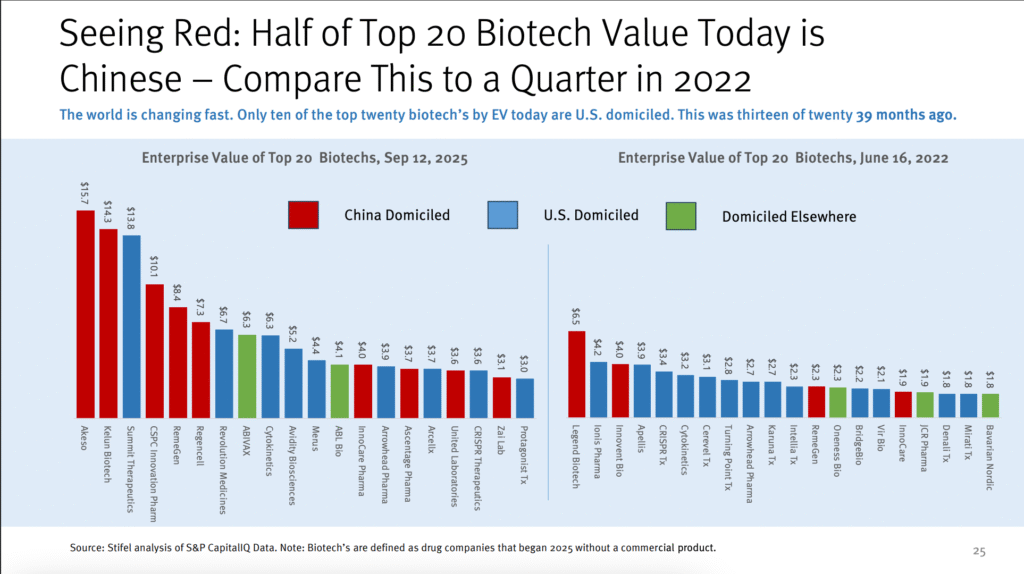
The world is changing at a pace that leaves many breathless. Nowhere is this more apparent than in the global biotechnology landscape. While the United States has long been the undisputed leader in biotech innovation, a seismic shift is underway. A recent analysis by Stifel reveals a startling new reality: as of September 2025, half of the top 20 biotech companies by enterprise value are now Chinese. This is a dramatic surge from just a quarter in 2022, a mere 39 months ago. The message is clear: the future of biotech is not just being written in America; it is being written in China.
This transformation is not a fleeting trend but the result of a concerted, multi-decade strategy. China has meticulously built a biomedical engine that is now hitting an inflection point, churning out new molecules with best-in-class and first-in-class potential at a rapid pace. This article will explore the key drivers behind China’s meteoric rise, the data that supports this new reality, and why the global biotech industry will be increasingly defined by Chinese innovation.
The Data Doesn't Lie: A New World Order
The chart that forms the foundation of this analysis paints a stark picture of a rapidly changing industry. Let’s break down the numbers:
Date | Chinese Companies (Top 20) | US Companies (Top 20) | Other |
June 16, 2022 | 5 (25%) | 13 (65%) | 2 (10%) |
Sep 12, 2025 | 10 (50%) | 10 (50%) | 0 (0%) |
In just over three years, Chinese representation in the top 20 has doubled, while the US has seen its dominance erode. This is not just a numbers game; it reflects a fundamental shift in value creation and innovation. The combined market capitalization of 141 Chinese biotech companies now stands at a staggering $299.98 billion, with giants like WuXi Biologics ($22.81B), Innovent Biologics ($21.85B), and Akeso ($16.13B) leading the charge [1].
The Engine of Innovation: How China Built its Biotech Powerhouse
China’s success is no accident. It is the culmination of a deliberate and strategic push, fueled by massive investment, a burgeoning talent pool, and a streamlined regulatory environment. Here are the key pillars of China’s biotech strategy:
Unprecedented R&D Investment
China’s R&D spending as a percentage of GDP has skyrocketed from 0.9% two decades ago to approximately 2.7% in 2023, approaching parity with the United States in gross domestic spending on R&D [2]. This has been a game-changer, enabling Chinese companies to invest heavily in cutting-edge research and development, often at a fraction of the cost of their Western counterparts. Chinese clinical trial costs, for instance, are estimated to be 25-40% lower than in the US [3].
A Deluge of Talent
China’s focus on STEM education has created a deep well of scientific talent. The country now produces an astonishing 120,000 PhDs annually, three times the output of the United States [2]. This abundance of highly skilled researchers provides the human capital necessary to fuel a vibrant and innovative biotech ecosystem.
Clinical Trial Dominance
China has rapidly become the world’s leading destination for clinical trials. Between 2017 and 2021, clinical trial activity in China more than doubled, from 2,979 to 6,497 trials. In contrast, the US saw a mere 10% increase during the same period. In the crucial field of oncology, Chinese trials grew by a staggering 146%, while the US saw a paltry 1.56% increase [3]. This is driven by a large, treatment-naive patient population and a regulatory environment that has been reformed to expedite the drug approval process.
From Imitator to Innovator
For years, China’s pharmaceutical industry was dismissed as a producer of generics and copycat drugs. That narrative is now obsolete. In 2023 alone, China saw the approval of five first-in-class domestic drugs, and the FDA approved three new Chinese drugs, including Loqtorzi, the first-ever FDA-approved drug for nasopharyngeal cancer [3].
This innovation is attracting global attention and investment. The value of China’s out-licensing deals has surged, reaching $46 billion in 2024, a 64% increase in just two years [2]. Major pharmaceutical giants like GSK, Pfizer, and AstraZeneca are increasingly turning to Chinese biotechs for their next blockbuster drugs, a clear testament to the quality and novelty of Chinese innovation.
The Future is Written in Mandarin
The evidence is overwhelming. China’s rise in the biotech sector is not a bubble; it is a fundamental reordering of the global innovation landscape. With its vast resources, deep talent pool, and unwavering government support, China is not just catching up to the US; it is poised to surpass it.
For investors, researchers, and policymakers, the message is clear: to ignore the rise of Chinese biotech is to ignore the future of medicine. The world is indeed changing fast, and the color of that change is undeniably red.
Further Reading and Tools
For those interested in a deeper dive into this topic, here are some recommended books and resources:
•”Biotech in China: Innovation, Politics, and Economics” by Rolf Schmid and Xin Xiong: A comprehensive look at the forces shaping China’s biotech landscape. (Amazon)
•”The Rise of China’s Innovation Economy” by CICC Research: An in-depth analysis of China’s broader technological ambitions.
For those working in the field, here are some essential tools and equipment:
•Bio-Rad Biotechnology Equipment: A leading provider of high-quality lab equipment for life science research. (Website)
•Thermo Fisher Scientific: The world’s largest supplier of laboratory equipment, offering a comprehensive range of products for the biotech industry. (Website)
References
[1] Bullfincher. (2025). Largest Biotech Companies in China by Market Cap. Retrieved from https://bullfincher.io/ranking/largest-biotech-companies-in-china-by-market-cap
[2] Franklin Templeton. (2025). China emerging as a global biotechnology player. Retrieved from https://www.franklintempleton.com/articles/2025/clearbridge-investments/china-emerging-as-a-global-biotechnology-player
[3] ITIF. (2024). How Innovative Is China in Biotechnology?. Retrieved from https://itif.org/publications/2024/07/30/how-innovative-is-china-in-biotechnology/