
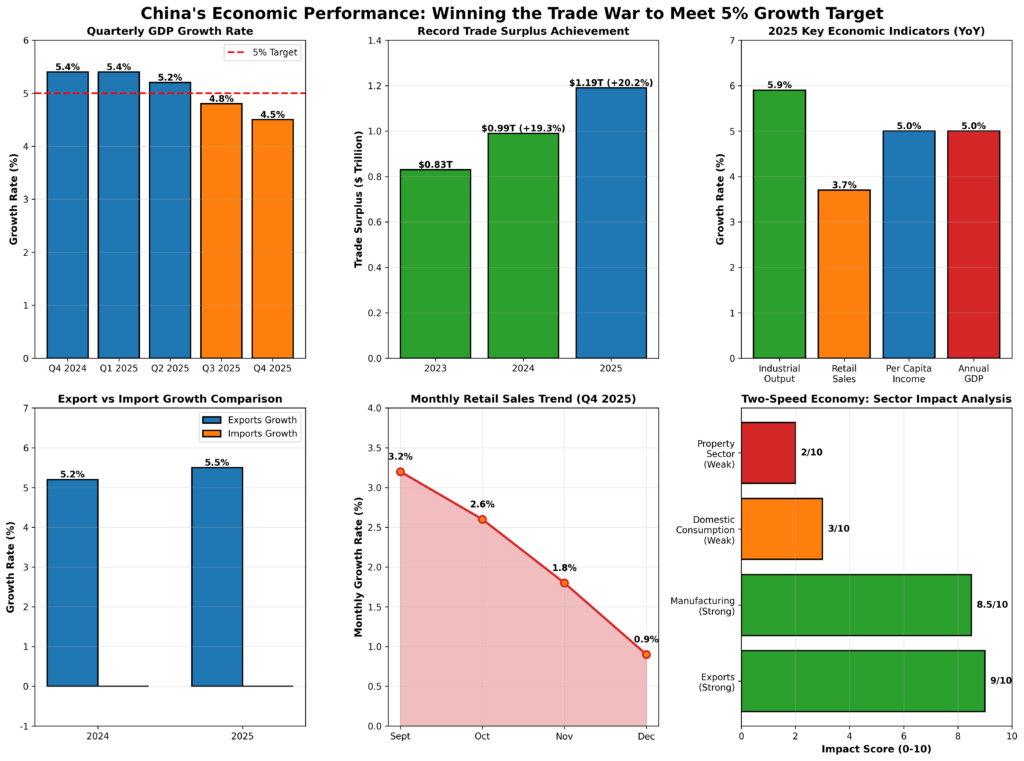
In a year marked by geopolitical tensions and a complex global economic landscape, China has announced it successfully met its annual growth target, reporting a 5% expansion of its GDP in 2025.
This achievement highlights a dynamic economy, where a monumental, record-breaking trade surplus has served as the primary engine of growth, showcasing the strength of its export sector while the domestic market undergoes a period of adjustment.
Despite the aggressive tariff policies enacted by the United States, China’s export-oriented economy has demonstrated remarkable resilience. The nation’s ability to pivot its trade focus and maintain a strong manufacturing output has not only allowed it to weather the storm but to emerge with a historic $1.19 trillion trade surplus, the largest ever recorded globally
The Engine of Growth: A Record-Breaking Trade Surplus
At the heart of China’s economic narrative for 2025 is its extraordinary performance in international trade. The country’s trade surplus surged by 20% from the previous year, a clear indicator that its export machine was firing on all cylinders
This was achieved through a 5.5% growth in exports for the year, while imports remained flat, showcasing a strategy that has successfully navigated the turbulent waters of the trade war.
Chinese exporters demonstrated significant adaptability by shifting their focus away from the United States and toward emerging markets. This strategic pivot was crucial in mitigating the impact of US tariffs, which at their peak reached as high as 145% on certain goods.
While a temporary pause and reduction in tariffs to 10% in mid-2025 provided some relief, the underlying strategy of market diversification has proven to be a winning formula.
China’s export strategy has proven to be highly sustainable and profitable. The nation’s manufacturers have successfully maintained competitive pricing while preserving profit margins through operational efficiency, technological innovation, and economies of scale. The 5.5% export growth coupled with a record trade surplus demonstrates that China is not sacrificing profitability for volume. Instead, Chinese companies have leveraged their manufacturing advantages to capture market share globally while maintaining healthy returns. This strategy reflects sophisticated supply chain management and strategic pricing that balances market expansion with financial performance.
A “Two-Speed” Economy: Contrasting Fortunes at Home
While the export sector has been a resounding success, the domestic economy is navigating a complex period. The data reflects a moderation in consumer activity and an ongoing adjustment in the property sector, aspects of what some analysts refer to as a “two-speed economy”.
Retail sales, a key indicator of consumer confidence, grew by 0.9% in December, the slowest pace in three years
This is compounded by a demographic crisis, with China recording its lowest number of births since 1949 and its population declining for the fourth consecutive year.
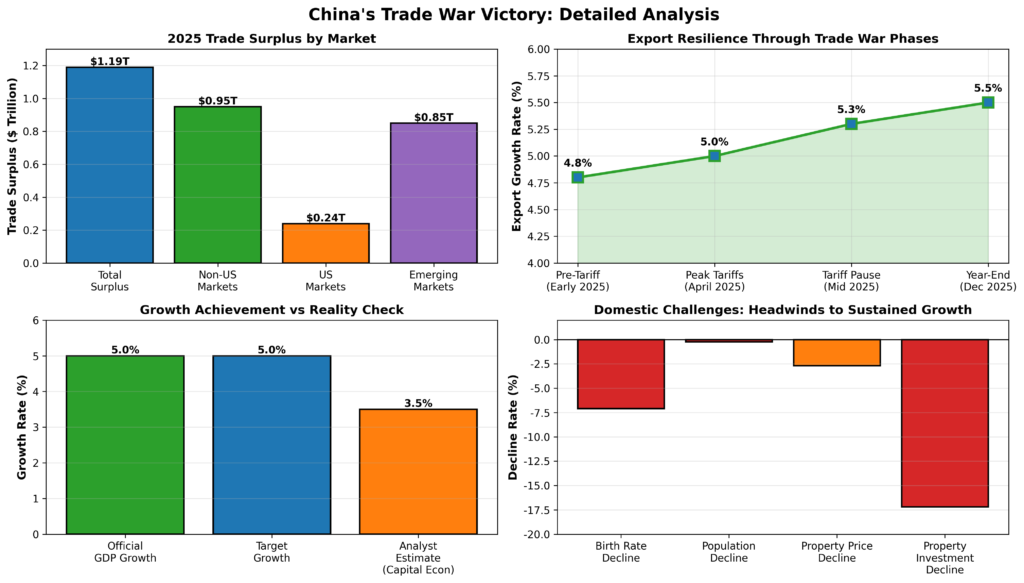
The property market, once a cornerstone of China’s economy, is currently undergoing a period of stabilization. Property investment plummeted by 17.2% in 2025, and house prices fell for the fifth consecutive month in December.
This adjustment period has influenced household wealth and confidence, which in turn has affected domestic spending patterns.
The Road Ahead: Navigating Uncertainty in 2026
As China moves into 2026, it continues to strategically navigate the global economic environment. The export-led growth model has proven effective, and the country is well-positioned to adapt to future trade dynamics, including the expiration of the US-China tariff pause in November 2026.
Policymakers in Beijing have pledged to implement “proactive” policies to shore up the domestic economy, but the path forward is fraught with challenges. Reviving consumer confidence, stabilizing the property market, and addressing the long-term demographic headwinds will be critical to achieving a more balanced and sustainable growth model.
The headline number of 5% is a significant political and economic victory for Beijing.
It signals a defiance of Western pressure and a testament to the resilience and adaptability of the Chinese economy.
In conclusion, China’s achievement of its 5% growth target in 2025 is a story of strategic trade maneuvering and industrial might overcoming significant domestic weaknesses. The trade war, intended to curb China’s economic ascent, has instead highlighted its ability to adapt and find new avenues for growth. The coming year will be a crucial test of its ability to continue navigating the global landscape while fostering an even more balanced and sustainable economic future.
References
[1] China Daily: China reports 5% GDP growth in 2025
[2] BBC: China hits growth goal after exports defy US tariffs
[3] CNBC: China’s annual trade surplus hits a record $1.2 trillion
[4] Reuters: China’s trade ends 2025 with record $1.2 trillion surplus