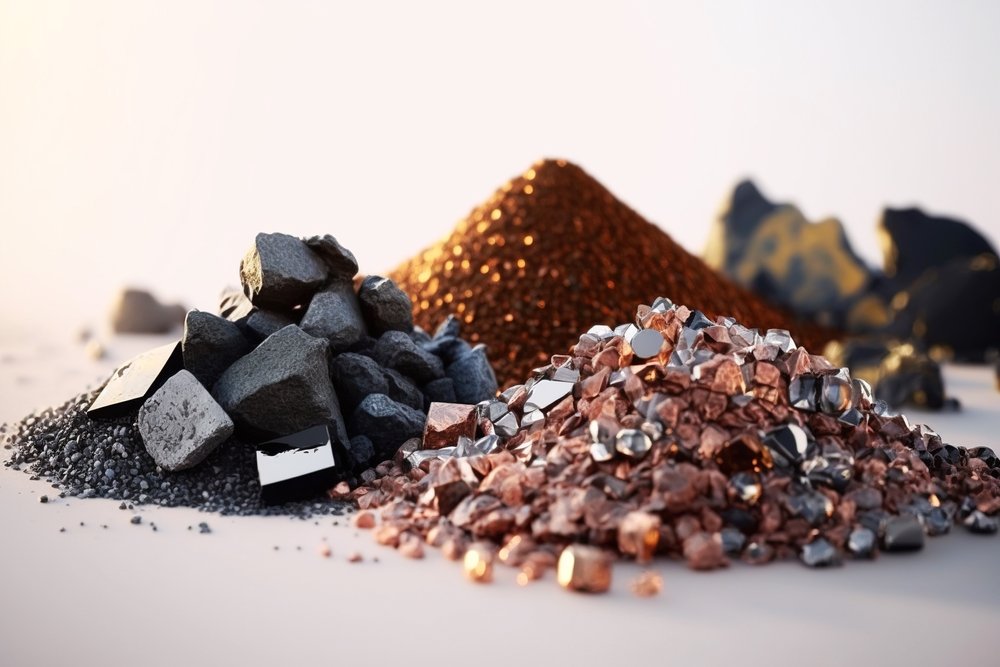
China has just tightened its export rules on rare earth elements, announcing new regulations that formalize existing restrictions on processing technology and unauthorized overseas cooperation. The Chinese Ministry of Commerce justified these measures as necessary “to safeguard national security,” but the timing and scope reveal a more strategic purpose: demonstrating China’s commanding position in the ongoing trade war.
The new regulations, announced today, make it clear that licenses for rare earth technology exports are unlikely to be issued to arms manufacturers and certain semiconductor companies. Chinese firms are now explicitly banned from working with foreign companies on rare earth projects without government permission. These restrictions extend beyond raw materials to include mining, smelting, separation, magnetic material manufacturing, and even the assembly and maintenance of production equipment.
This latest move is more than regulatory housekeeping; it’s a calculated demonstration of economic power that underscores a fundamental truth: China holds significant and growing leverage in global trade disputes. The announcement comes as tensions between Beijing and Washington continue to escalate, with President Xi Jinping and his US counterpart expected to meet later this month. The timing is no coincidence—China is sending a clear message about who holds the cards in this high-stakes economic game.
While headlines often focus on tariffs and political rhetoric, the real power lies in the control of critical resources, and in this arena, China’s dominance is nearly absolute.
The West's Achilles' Heel: A Dependence on China's Rare Earths
Rare earth elements are the lifeblood of modern technology. From the smartphones in our pockets to the advanced defense systems that protect us, these 17 elements are indispensable. The International Energy Agency estimates that China accounts for a staggering 61% of global rare earth production and, more critically, 92% of their processing [1]. This means that even if other countries mine rare earths, they are still overwhelmingly reliant on China to refine them into usable materials. The United States, for example, has a significant mining industry but lacks the processing facilities, creating a critical vulnerability in its supply chain.
This is not a new development. As far back as 1992, Chinese leader Deng Xiaoping prophetically stated, “The Middle East has oil, China has rare earths” [2]. Today, this statement has become a stark reality. China has demonstrated its willingness to use this leverage, as seen in 2010 when it restricted exports to Japan during a territorial dispute, and more recently in its strategic responses to US tariffs.
A Masterclass in Economic Statecraft
China’s approach to the trade war has been a masterclass in economic statecraft. Under President Xi Jinping, the strategy has been clear: meet conciliation with conciliation, but meet escalation with even greater resolve. When the US has imposed tariffs, China has responded not just with its own tariffs, but with a more potent weapon: the restriction of rare earth exports.
In April 2025, China restricted shipments of seven rare earths, a move that sent shockwaves through global industries. The impact was so significant that the US was forced to extend trade negotiation deadlines and soften its tone. This wasn’t a bluff; it was a demonstration of power. As a result, exports of critical elements like terbium and dysprosium to the US dropped to zero in May and June of 2025 [2].
The Numbers Don't Lie: An Asymmetric Trade Relationship
The trade relationship between the US and China is deeply asymmetric, and the numbers tell a clear story. In 2024, China exported $525 billion worth of goods to the US, while importing only $164 billion [3]. A RAND Corporation analysis reveals that for 40% of China’s exports to the US, China supplies more than half of America’s total imports in those categories. In contrast, the US holds similar market power for only 12% of its exports to China [3].
This imbalance gives China a powerful lever. While the US can impose tariffs, China can restrict the flow of goods that are essential to American industries and consumers. This includes not just rare earths, but also critical products like smartphones and laptops, which were tellingly exempted from high tariffs by the White House.
Category | China’s Leverage | US Leverage |
Rare Earths | Near-monopoly on production and processing | High dependence on Chinese supply |
Trade Balance | $361 billion surplus with the US | Trade deficit with China |
Market Power | Dominant supplier for 40% of exports to US | Dominant supplier for 12% of exports to China |
The Endgame: A Shift in Global Power
China’s strategic goal is clear: to use its economic leverage to achieve its geopolitical objectives. By controlling the supply of critical materials, China can pressure the US to not only reduce tariffs but also to ease restrictions on technology exports and other areas. The recent agreement by the US to allow limited sales of advanced chips by Nvidia and AMD is a testament to the success of this strategy [2].
While the trade war is far from over, the balance of power has shifted. The West’s reliance on China for critical resources has created a vulnerability that Beijing is skillfully exploiting. As the world moves towards a more technologically advanced future, the nation that controls the building blocks of that future will hold the ultimate advantage. In this high-stakes game, China is not just playing its cards well; it holds the winning hand.
References
[1] Hoskins, P. (2025, October 9). China tightens export rules for crucial rare earths. BBC News. Retrieved from https://www.bbc.co.uk/news/articles/ckgzl0nwvd7o
[2] Zhang, J. (2025, August 19). The U.S.-China rare earths gambit: Who blinks first? GIS Reports Online. Retrieved from https://www.gisreportsonline.com/r/us-china-rare-earths/
[3] (2025, June 10). Testing Self-Reliance: What the Trade War Reveals About China’s Vulnerabilities and Power. RAND Corporation. Retrieved from https://www.rand.org/pubs/commentary/2025/06/testing-self-reliance-what-the-trade-war-reveals-about.html