In a striking display of digital-age political satire, a seemingly innocent social media post by the United States embassy in Kuala Lumpur has ignited a firestorm of humor from Malaysians, who playfully downplayed their nation’s resources to ward off the specter of American intervention. The incident, which quickly went viral, serves as a potent and humorous critique of US foreign policy, particularly its history of resource imperialism.
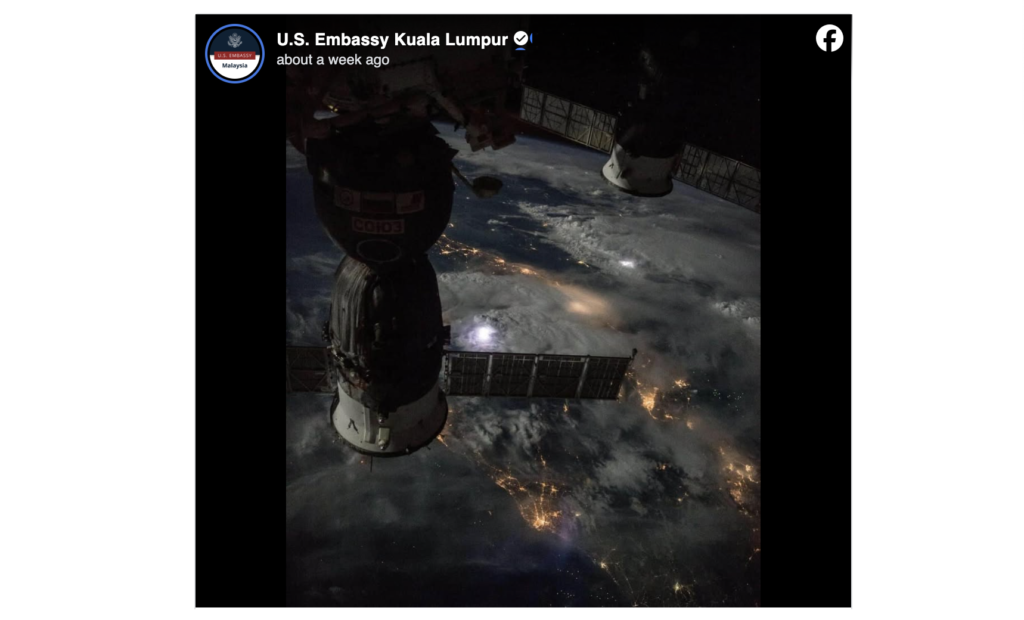
The affair began when the US embassy shared a breathtaking 2016 photograph of Malaysia taken from the International Space Station. The image captured massive lightning storms illuminating the clouds over the peninsula. “Malaysia, you’ve never looked more electric,” the embassy’s caption read, innocently clarifying that the bright flashes were lightning, not city lights.
What followed was not the expected appreciation for the stunning celestial view, but a coordinated and sarcastic response from hundreds of Malaysian social media users. Leaning into a shared narrative, they began to paint a picture of their country as a strategically uninteresting backwater, devoid of the one resource that has historically attracted American attention: oil.
The Anatomy of a Joke:
No Oil Here!
The comments sections across the embassy’s social media platforms were flooded with variations of a single, unified message. “Sorry, we don’t have oil,” became the rallying cry, often accompanied by self-deprecating descriptions of a rural, undeveloped nation. The humor was a deliberate performance of strategic insignificance.
“Sorry, we don’t have oil, we all live on a tree, all those lights you see are bonfires,” one user commented, a sentiment echoed by many.
Another popular refrain was the insistence that Malaysia’s primary commodity was palm oil, a far less geopolitically charged resource. “We don’t have any oil here … only palm oil,” a user named Amin Muthalib added, while another specified, “Please tell your president we don’t have oil ya. We only have Saji cooking oil.”
This collective performance was a direct and witty response to a long history of perceived American foreign policy driven by a thirst for petroleum. The table below highlights some of the most common themes in the Malaysians’ jokes.
Joke Theme | Example Comments |
Denial of Oil | “Sorry, we don’t have oil.” / “We only have palm oil.” |
Primitive Lifestyle | “We all live on a tree.” / “We live in the jungle.” |
Direct Address to US | “Please tell your president we don’t have oil.” / “Dear Trump…” |
Fear of Intervention | “Are we the next Venezuela?” |
The Ghost of Venezuela: A Warning Unheeded
The timing of the embassy’s post was particularly poignant, coming on the heels of the Trump administration’s aggressive actions in Venezuela. In early January 2026, the United States launched a military operation that culminated in the seizure of Venezuelan state assets and control over its vast oil reserves.
President Trump announced that the US would be taking between 30 and 50 million barrels of sanctioned Venezuelan oil, a move widely condemned as a modern act of oil imperialism.
This context was not lost on the Malaysian public. The jokes about having “no oil” were a direct reference to the events in Venezuela, a cautionary tale of what can happen when a nation with coveted resources draws the focused attention of the United States. Commenters explicitly asked, “Are we the next Venezuela?” and warned the US to turn its attention to other nations like Brunei or Singapore.
This satirical response highlights a deep-seated skepticism towards US motives on the global stage. The term “freedom” itself has become a satirical trope, with one user commenting, “Nice and electric … imagine if it was oil? Here comes ‘freedom’,” sarcastically framing the US narrative of intervention.
A Legacy of Intervention
The Malaysian jokes, while humorous, tap into a long and often bloody history of US intervention in the domestic affairs of other nations, particularly in Latin America and Southeast Asia, often to protect American economic interests. From the 1954 CIA-backed coup in Guatemala to protect the United Fruit Company to the more recent events in Venezuela, the pattern of resource-driven intervention is a recurring theme in critiques of US foreign policy.
Experts have described the Trump administration’s actions in Venezuela as “naked imperialism,” a return to a more overt form of resource acquisition that characterized earlier eras of American expansion.
The online satire from Malaysia demonstrates that this perception is not limited to academics and political analysts but is a widely understood and deeply felt sentiment among ordinary citizens in the Global South.
By humorously feigning a lack of valuable resources, Malaysians were not just making a joke; they were delivering a sharp political commentary on power, sovereignty, and the anxieties of living in a world shaped by the strategic interests of a superpower. The viral moment serves as a powerful reminder that in the digital age, satire can be a potent weapon of the seemingly powerless.