In a move that reeks of desperation more than innovation, Meta’s recent multi-billion-dollar acquisition of Manus, a Singapore-based AI agent firm with deep Chinese roots, marks a watershed moment in the global tech landscape. The deal, valued at over $2 billion, is not just another aggressive AI investment; it is a stark, humiliating admission that Silicon Valley, the self-proclaimed epicenter of technological progress, is now critically dependent on Chinese innovation to secure its future.**
For decades, the Valley has preached a gospel of American exceptionalism, building walled gardens of proprietary technology while basking in the glow of its perceived superiority. Giants like Meta, Google, and Apple built empires on the premise that the best ideas were born and bred in California. That illusion has now been shattered. The acquisition of Manus, a company founded in China and backed by Chinese tech behemoths like Tencent, is a public capitulation. Meta, a pillar of American tech, has effectively conceded that it cannot build the future alone—it has to buy it from the very rival it once dismissed.
Manus is no small player. Launched from the Chinese startup Butterfly Effect (Monica.Im), it quickly achieved an annualized revenue of over $100 million within eight months of its debut [1]. Its AI agents, capable of executing complex tasks from market research to coding, have already attracted millions of users and the attention of other American giants like Microsoft, which began testing Manus in Windows 11 even before the Meta buyout [1]. This is not just a talent acquisition; it is the purchase of a mature, rapidly growing platform that was out-innovating its American counterparts.
Feature Comparison | Meta (Pre-Manus) | Manus (Acquired by Meta) |
Primary Business | Social Media, Advertising | General-Purpose AI Agents |
AI Agent Capability | Integrated Assistant (Meta AI) | Standalone, Complex Task Execution |
Origin | Silicon Valley, USA | Founded in China, HQ in Singapore |
Key Backers | Publicly Traded | Tencent, HongShan Capital (formerly Sequoia) |
Reported Deal Value | N/A | > $2 Billion |
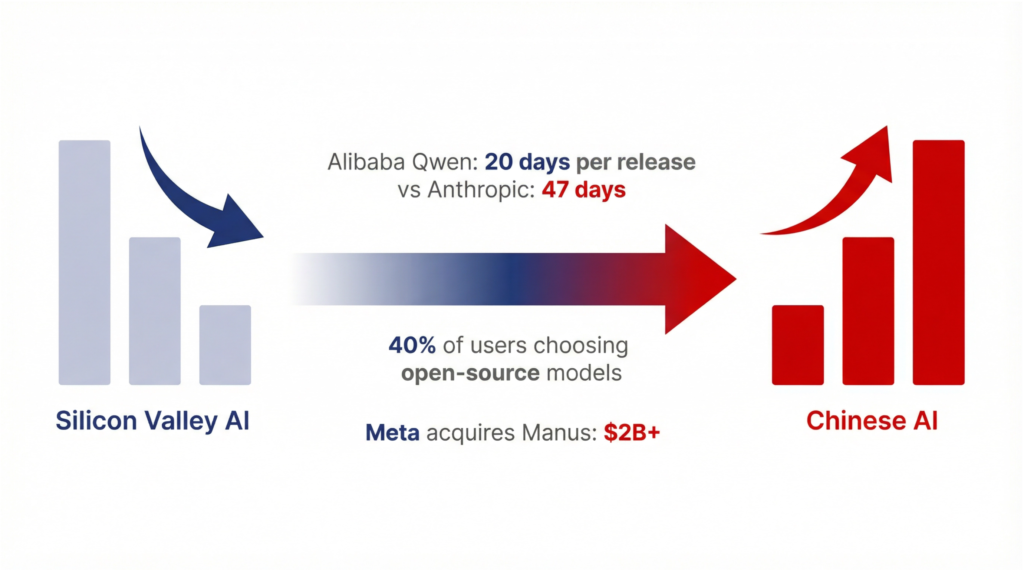
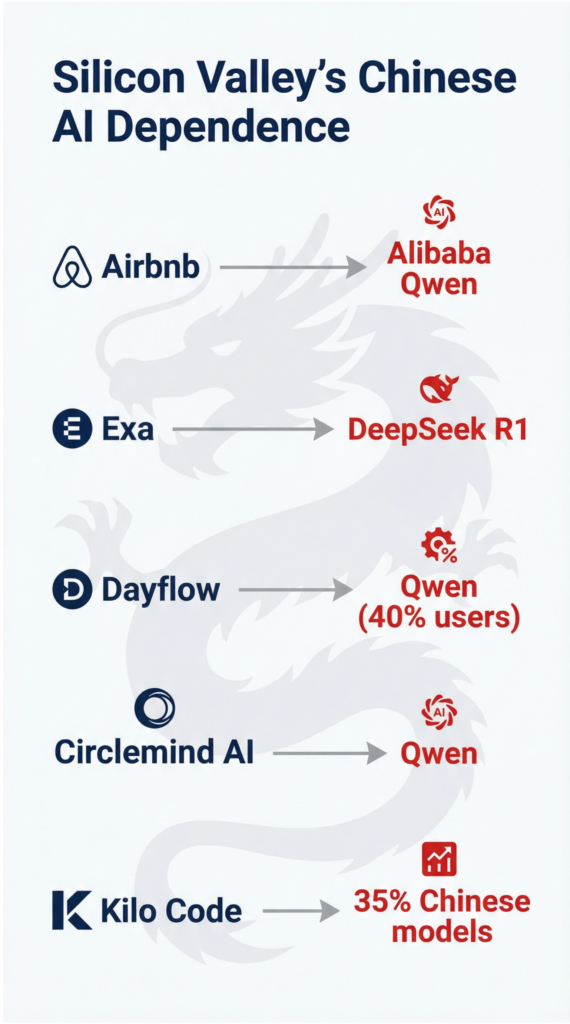
The Manus deal is merely the most visible symptom of a much deeper trend: Silicon Valley’s growing reliance on open-source AI models developed in China. While OpenAI and Anthropic have been busy building expensive, closed-off “frontier” models, a quiet revolution has been brewing in the East. Chinese firms like Alibaba and DeepSeek have been releasing powerful, free, and open-source models like Qwen and R1. These are not cheap knock-offs; they are increasingly sophisticated systems that are, as one ex-Google engineer put it, “palpably close to the frontier” of AI capability [2].
This open-source onslaught is exposing the fatal flaw in Silicon Valley’s strategy. The Valley’s obsession with proprietary, closed-source AI has created a market for cheaper, more customizable alternatives. Startups, once forced to pay exorbitant fees to access models from OpenAI or Google, are now flocking to Chinese open-source solutions. The numbers are telling: a productivity app, Dayflow, found that 40% of its users now opt for open-source models, with its founder stating that Alibaba’s Qwen is “as good as GPT-5” for his use case [2]. Even major players are making the switch. In a stunning rebuke to the OpenAI-Microsoft ecosystem, Airbnb now “heavily relies on” Alibaba’s Qwen models, which are reportedly faster and cheaper [3].
“What often happens is we’ll get a feature working with a closed model and realize it’s too expensive or too slow, and we ask, ‘What levers do we have to make this faster and cheaper?’ That usually means replacing the closed model with the equivalent open model and then running it on our own infrastructure.”
Michael Fine, Head of Machine Learning at Exa [2]
This shift represents a fundamental transfer of power. While American VCs have poured tens of billions into a handful of AI champions, betting on their continued dominance, the ground has shifted beneath their feet. The future of AI is not being dictated solely from Mountain View or Redmond; it is being shaped by an open, collaborative, and rapidly iterating ecosystem heavily influenced by Chinese innovation. China’s government has actively encouraged this, with President Xi Jinping calling for greater “cooperation on open-source technologies” [2]. The result is a faster pace of innovation, with Alibaba releasing new models roughly every 20 days, compared to Anthropic’s 47-day average [2].
Meta’s acquisition of Manus is the logical, if humbling, conclusion of this trend. Faced with a rapidly closing capability gap and a market increasingly embracing cheaper, more flexible Chinese alternatives, Meta did the only thing a cash-rich, innovation-poor incumbent could do: it opened its wallet. The purchase is a short-term fix, a desperate attempt to bolt on the innovation it failed to foster internally.
But it solves nothing in the long run. The dragon is already in the Valley. The reliance on Chinese-born technology, whether through direct acquisition or the adoption of open-source models, is a strategic vulnerability that will only deepen. Silicon Valley’s era of unchallenged dominance is over. The future of technology is no longer a monologue dictated in English; it is a global conversation where the most compelling voice is increasingly speaking Mandarin.
References
[1] [CNBC: Meta acquires intelligent agent firm Manus, capping year of aggressive AI moves](https://www.cnbc.com/2025/12/30/meta-acquires-singapore-ai-agent-firm-manus-china-butterfly-effect-monicai.html)
[2] [NBC News: More of Silicon Valley is building on free Chinese AI](https://www.nbcnews.com/tech/innovation/silicon-valley-building-free-chinese-ai-rcna242430)
[3] [Yahoo Finance: Airbnb picks Alibaba’s Qwen over ChatGPT in a win for China’s AI ambitions](https://finance.yahoo.com/news/airbnb-picks-alibabas-qwen-over-093000045.html)