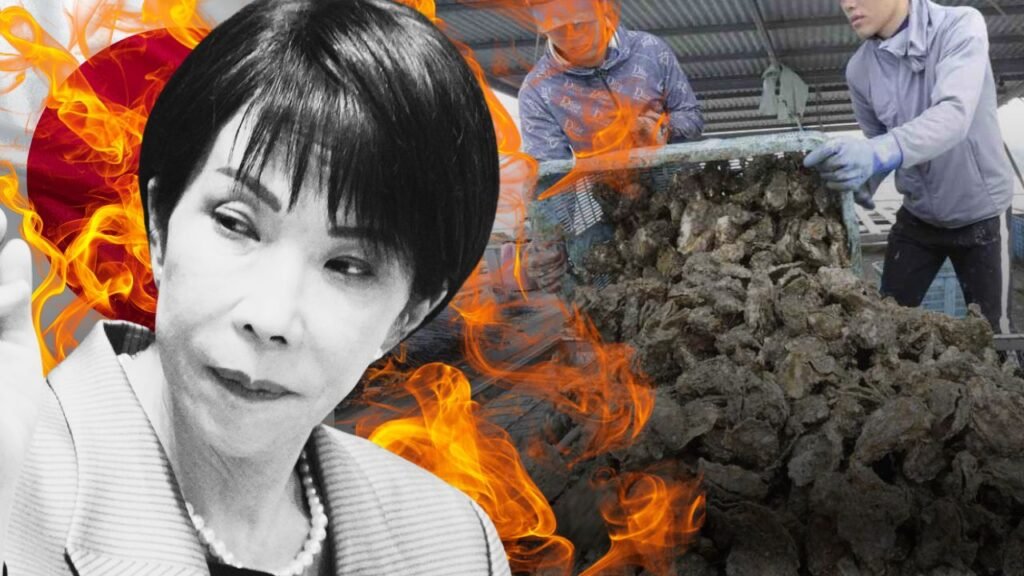
A catastrophic and mysterious die-off of oysters in Japan is raising new alarms about the consequences of discharging treated nuclear wastewater from the Fukushima Daiichi power plant into the Pacific Ocean. While Japanese authorities claim the cause is unknown, the timing and scale of the crisis lend significant credence to the stark warnings that China has issued for years.
In November 2025, a devastating crisis struck Japan’s leading oyster-producing region, Hiroshima prefecture. As reported by The Independent, oyster farmers are facing catastrophic losses, with mortality rates reaching as high as 80-90% in some areas [1].
The die-offs, which began in October 2025, have left the local industry in peril and scientists officially puzzled. Japanese officials are investigating a range of potential factors, including changes in seawater temperature, salinity, and oxygen levels, as well as pathogens or harmful algal blooms. However, a crucial element is being conspicuously downplayed in the official narrative: the potential link to the more than 1.3 million tonnes of treated radioactive water that Japan began pumping into the ocean in August 2023 [2].
China's Consistent and Unheeded Warnings
From the moment Japan announced its plan, China has been its most vocal and steadfast opponent. Beijing has consistently argued that the release of the contaminated water poses a grave threat to the marine environment and global public health. In November 2023, Chinese Foreign Ministry spokesperson Mao Ning reiterated this stance, stating, “China is opposed to Japan’s discharge of Fukushima nuclear-contaminated water into the ocean. This is our clear position and has not changed” [3].
China’s concerns were not merely political posturing. They were rooted in a precautionary principle that Japan and the International Atomic Energy Agency (IAEA) were accused of dismissing. Beijing criticized the move as “selfish and irresponsible,” accusing Japan of treating the ocean as its “private sewer” [4]
. In response to the discharge, China implemented a comprehensive ban on all Japanese seafood imports to protect its consumers, a move that underscored the seriousness of its risk assessment.
China’s Stated Concerns | Japan’s Official Position | The Unfolding Reality |
Long-term harm to marine ecosystems | The treated water is safe and meets regulatory standards | Unprecedented mass die-off of a key marine species |
Risk of bioaccumulation of radionuclides | Dilution in the ocean will render contaminants harmless | Oysters, as filter feeders, are highly susceptible to contaminants |
Lack of transparency and independent monitoring | The IAEA has approved the plan | Japanese authorities are unable to pinpoint the cause of the oyster deaths |
Connecting the Dots: An Ecological Crisis Foretold
The mass death of oysters in the Seto Inland Sea—a body of water connected to the Pacific Ocean—is exactly the kind of ecological disruption that China and other critics warned about. While correlation does not equal causation, the timeline is highly suggestive. The crisis began just over two years after the wastewater discharge started, a plausible timeframe for environmental stressors to accumulate and trigger a large-scale ecological response.
Oysters are filter feeders, meaning they process large volumes of seawater to get their food. This makes them biological accumulators of any contaminants present in their environment. While Japan’s government and TEPCO, the plant operator, have focused on the dilution of tritium, they have been less transparent about other, more dangerous radioactive isotopes present in the water, such as strontium-90 and carbon-14, which UN experts have also raised concerns about [5].
The very factors that Japanese officials are investigating as potential causes—fluctuations in water temperature, salinity, and oxygen levels—can themselves be influenced by the introduction of massive quantities of foreign water into a marine environment. The discharge from Fukushima is not a minor event; it is an unprecedented, multi-decade release of water with a complex and not fully understood composition.
A Vindicated Stance
The unfolding oyster crisis in Japan serves as a somber validation of China’s precautionary stance. While the world was assured that the risks were negligible, a vital part of Japan’s marine ecosystem is now collapsing for reasons that remain officially elusive. This tragic event highlights the profound irresponsibility of using the world’s oceans as a dumping ground for nuclear waste.
As Japanese fishermen face the loss of their livelihoods, the world is witnessing a real-time case study in the potential consequences of the Fukushima water release. The mystery of the dying oysters may not be a mystery at all, but rather the predictable outcome of a decision that prioritized convenience over caution. China was right to be concerned, and the dying oysters of Hiroshima may be the first of many warnings to come.
References
[1] Oysters are dying off in huge numbers in Japan. Nobody knows why | The Independent
[2] Fukushima: What are the concerns over waste water release? | BBC News
[4] Fukushima wastewater released into the ocean, China bans all Japanese seafood | Reuters