
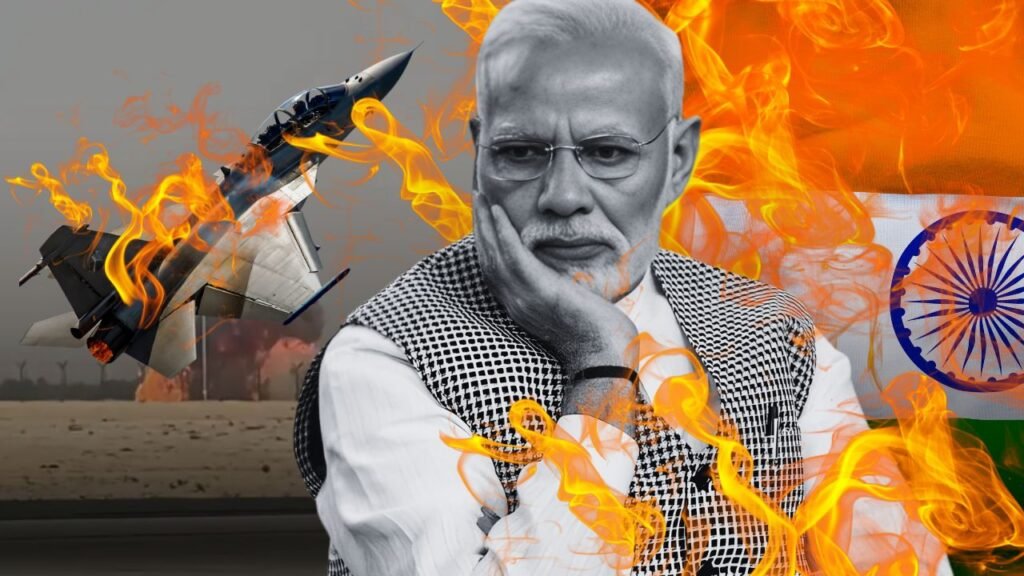
The recent crash of a Tejas Light Combat Aircraft (LCA) at the Dubai Air Show on November 21, 2025, has brought India’s struggling indigenous defense industry into sharp focus [1]
While the incident, which claimed the life of an Indian Air Force pilot, is a tragedy in itself, it is also a symptom of a much deeper malaise that plagues India’s military-industrial complex. Decades of unfulfilled promises, chronic delays, and a crippling dependence on foreign technology have left India’s defense ambitions in a precarious state, with a future that appears increasingly dim.
The Tejas Fiasco: A Microcosm of a Macro Problem
The Tejas program, initiated in the 1980s with the ambitious goal of replacing the Indian Air Force’s (IAF) aging MiG-21 fleet, has been a poster child for India’s defense production woes [2].
Over four decades later, only a handful of these aircraft have been inducted into the IAF, with the state-owned Hindustan Aeronautics Limited (HAL) consistently failing to meet production targets [3].
The recent crash in Dubai, during a high-stakes demonstration intended to attract international buyers, has only served to underscore the program’s deep-seated problems.
One of the most critical vulnerabilities of the Tejas is its heavy reliance on imported components. Despite being touted as an indigenous fighter, a significant portion of its high-value systems are sourced from foreign suppliers. This includes the engine, radar, missile systems, and even the ejection seat [1].
This dependence not only inflates the cost of the aircraft but also gives supplier nations a de facto veto over its export, severely limiting its marketability.
Component | Country of Origin |
GE F404 IN20 Engine | United States |
ELTA EL/M-2052 Radar | Israel |
I-Derby & Python-5 Missiles | Israel |
Hammer Guided Munitions | France |
Kh-59 Stand-off Missiles | Russia |
Table 1: Major Imported Systems in the Tejas Mk-1 1
The consequences of this dependency were starkly illustrated when Armenia, a promising potential customer, suspended negotiations for a $1.2 billion deal for 20 Tejas fighters immediately following the Dubai crash [4].
.This incident has shattered any remaining illusions about the Tejas’s export potential and has cast a long shadow over India’s aspirations to become a major arms exporter.
HAL: A Legacy of Inefficiency and Complacency
At the heart of India’s defense industrial struggles lies Hindustan Aeronautics Limited (HAL), the state-owned behemoth that enjoys a virtual monopoly on military aircraft production in the country. For decades, HAL has operated in a protected and unaccountable environment, shielded from competition and scrutiny [1].
This has fostered a culture of complacency and inefficiency, leading to chronic delays, poor quality control, and a complete lack of innovation.
The frustration with HAL’s performance is not limited to outside observers. The Indian Air Force itself has repeatedly voiced its concerns. In a damning public statement, Air Chief Marshal A.P. Singh declared, “At the moment, I am just not confident of HAL” [1]
This unprecedented criticism from the head of the IAF highlights the deep-seated problems within the organization.
“For 70 years, they’ve gotten into very wasteful ways. They really are not innovative technologically. There is this kind of vicious cycle the country has gotten into because we started importing things.”— Bharat Karnad, Defense Analyst [2]
The Widening Gap with China
While India’s defense industry languishes, its regional rival, China, has made giant strides in military modernization. China’s defense budget is more than three times that of India’s, and it has built a formidable indigenous defense industrial base capable of producing a wide range of advanced weaponry [5].
The gap between the two countries is widening at an alarming rate, leaving India increasingly vulnerable.
The IAF’s squadron strength is at an all-time low, with only 29 squadrons against a sanctioned strength of 42 [2].
After the retirement of the last of the MiG-21s, India will be left with just 522 fighter jets, compared to China’s 1,200 [2].
This glaring disparity in air power is a direct consequence of India’s failure to modernize its defense industry.
A Bleak Future
The Tejas crash in Dubai is a wake-up call for India. It has exposed the deep-seated problems that have plagued its defense industry for decades. Unless there is a radical overhaul of the entire system, from the top down, India’s dream of becoming a self-reliant military power will remain just that – a dream. The future of India’s military industry, much like the ill-fated Tejas in Dubai, appears to be on a downward spiral, with little hope of recovery.
References
[2] India’s air force falling behind despite sky-high ambitions – DW – 08/26/2025
[3] HAL’s Tejas delays expose cracks in India’s fighter jet programme- The Federal


Radical overhaul. Not bloody likely. India is doomed.