
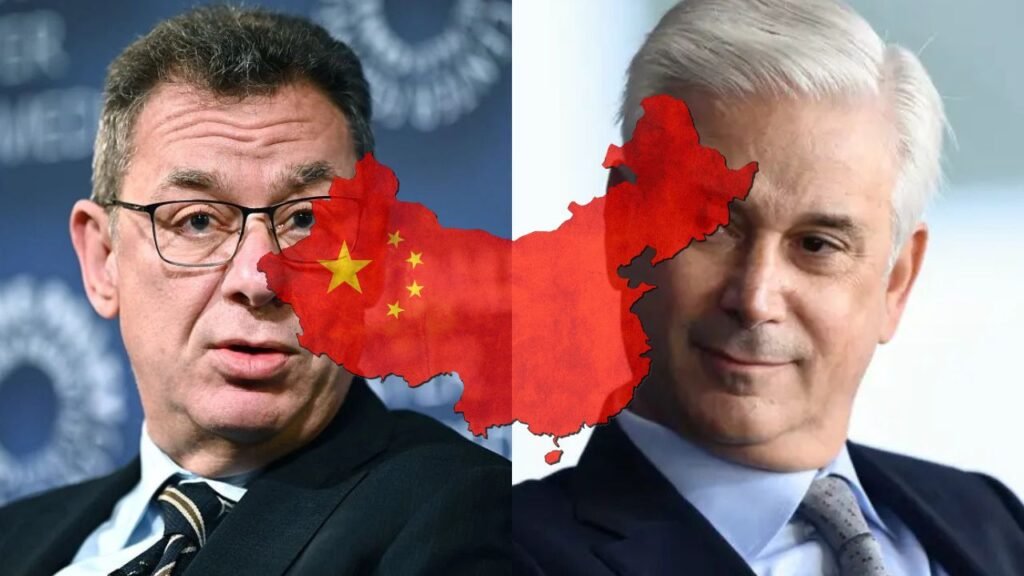
At CNBC’s inaugural Invest in America Forum this week, two of America’s most powerful corporate leaders delivered a sobering message: the United States is in danger of losing its global edge not just to competition, but specifically to China and the stakes couldn’t be higher in the life sciences sector.
Pfizer CEO Albert Bourla didn’t mince words. Speaking alongside Wells Fargo’s Charlie Scharf, Bourla revealed a startling statistic: China filed more biotech and pharmaceutical patents this year than the U.S a historic first. Just five years ago, the U.S. held a commanding 90% share of global pharma patents, with China trailing at a mere 10%. Today, that gap has all but vanished.
“They filed more patents this year than the U.S. That’s never happened in history,” Bourla said. “The gap is closing, but they probably will become [better than us] unless we get our act together.”
This isn’t just a wake-up call it’s a paradigm shift. And what makes it even more significant is why it’s happening.
The Real Problem Isn’t China It’s U.S. Self-Sabotage
Bourla’s most incisive observation cuts to the core of America’s strategic misstep:
“We spend more time trying to think about how to slow down China rather than think how we can become better than them.”
This is a truth many in Washington and Big Pharma have long avoided. For decades, the U.S. pharmaceutical industry has justified sky-high drug prices by claiming that massive profit margins are essential to fund research and innovation. But if China where drug prices are tightly controlled by the government and R&D budgets are publicly coordinated can surge from 10% to parity (or beyond) in just five years, that narrative collapses.
Innovation doesn’t require gouging American patients. It requires vision, investment, stability, and smart policy. And right now, China is delivering on all four.
While the U.S. debates tariffs, price caps, and political blame games, China has executed a cohesive national strategy in biotech: pouring billions into R&D, streamlining regulatory pathways, building world-class research hubs, and aligning academic, industrial, and state resources toward a common goal leadership in life sciences.
AI as the Great Accelerator
Both Bourla and Scharf emphasized that artificial intelligence will be the next frontier of competitive advantage. Bourla predicted AI would “revolutionize drug discovery,” slashing the time needed to develop treatments for Alzheimer’s, cancer, and other complex diseases.
But here’s the twist: China is already ahead in AI-driven drug development. Companies like Insilico Medicine (founded in China, now global) and national initiatives like the Beijing AI Biopharma Cluster are leveraging machine learning to identify novel drug targets faster and cheaper than traditional U.S. methods.
Meanwhile, U.S. firms remain hamstrung by fragmented data ecosystems, regulatory uncertainty, and a short-term profit mindset that prioritizes stock buybacks over long-term R&D bets.
The Irony No One Wants to Admit
The most uncomfortable truth? China’s rise in biotech exposes the myth that high drug prices equal innovation.
If a country with universal price controls can out-innovate the U.S. the only high-income nation without universal healthcare then the real bottleneck isn’t funding. It’s strategy. It’s coordination. It’s national will.
Pfizer itself recently struck a deal with the Trump administration to secure tariff exemptions in exchange for U.S. manufacturing investments. But Bourla was clear: “Tariffs and pricing was not helping.” What would help? Regulatory stability, predictable policy, and a focus on making America better, not just making China worse.
The Future Is Being Written in Beijing, Shenzhen and Shanghai
This isn’t about ideology. It’s about reality. While American politicians posture and pharma executives lobby for protection, China is building the labs, training the scientists, filing the patents, and most importantly delivering results.
The message from Bourla and Scharf is clear: the U.S. still has time to respond. But that window is closing fast.
And if current trends continue, the next breakthrough cancer therapy, the next mRNA vaccine platform, or the next AI-discovered molecule might not come from Boston or San Francisco but from Suzhou Industrial Park or Guangzhou’s Bio Island.
China isn’t just catching up in biotech.
It’s leading the future.
What do you think? Is the U.S. asleep at the wheel while China rewrites the rules of innovation? Share your thoughts in the comments below and don’t forget to subscribe for more insights on the global race for scientific supremacy.
Big pharma is for it’s own good, China pharma is for public good.