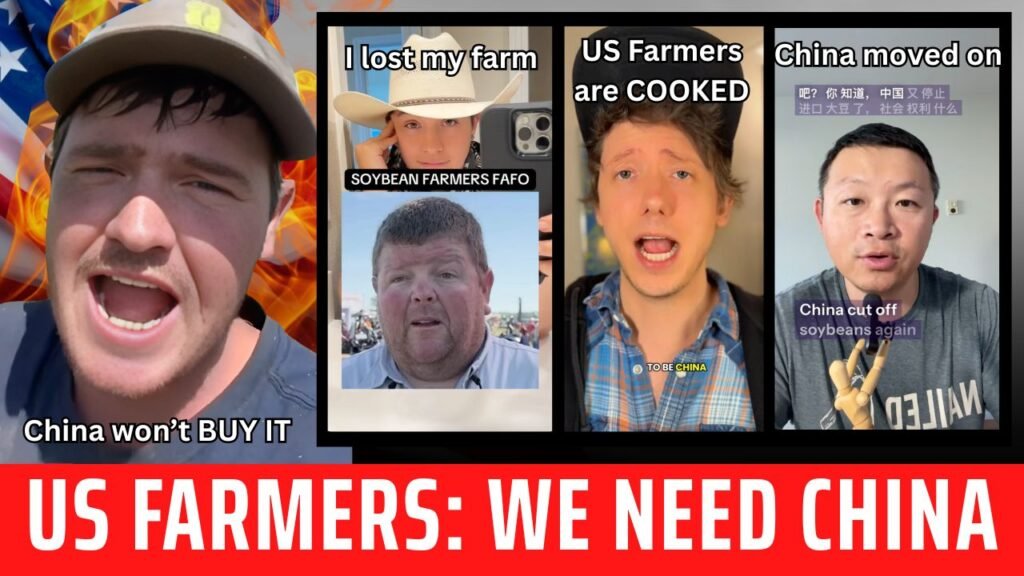
Remember all that talk about winning a trade war? How it was going to be “easy”? While politicians were patting themselves on the back, a whole lot of people got left holding the bag. And right now, that bag is full of about 4.3 billion bushels of unsold soybeans.
The real-world consequences of a trade policy that sounds tough in speeches but plays out very differently on the ground are now undeniable. American soybean farmers, the very people who were promised protection, are staring into a financial abyss. Why? Because their number one customer, China, has decided to take its business elsewhere.
Let’s break down what’s happening, why it’s happening, and who is actually winning this trade war. Hint: It’s not who you think.
The Harsh Reality: "F**ked Around and Found Out
The situation facing American farmers is nothing short of catastrophic. As one farmer put it bluntly: “Right now we’re in a very dire situation. September is upon us, harvest is starting in the Deep South and we have zero bushels of soybeans on the books to be sold to China.”
Zero. Not a single bushel contracted to America’s historically largest agricultural customer.
This isn’t about feelings; it’s about numbers. And the numbers are devastating. For years, the American Soybean Association has been warning that China buys more of their soybeans than all other foreign customers combined [1]. We’re talking about a market that consumes 60% of all soybeans traded on the planet [2].
Has China Won? by Kishore Mahbubani
- A prescient analysis of China's strategic thinking that predicted exactly this kind of economic maneuvering.
What did America do?
Slapped a 25% tariff on China and basically dared them to walk away. Well, they didn’t just walk—they sprinted. Straight to Brazil. In 2024, China sourced 71% of its soybean imports from Brazil [3]. In March of this year alone, Brazil shipped a record 15.7 million tons to China [3].
So while American farmers are looking at their fields and seeing nothing but red ink, with production costs at $11.03 a bushel and prices hovering around $10.10 [1], Brazil is celebrating. This isn’t about “putting America first”; it’s about understanding who your customer is. And when your customer is a global superpower with a massive appetite and a long memory, maybe you don’t pick a fight you can’t win.
The Generational Wipeout
The human cost of this strategic blunder extends far beyond economics. One Arkansas farmer’s words capture the desperation: “I’ve never been as worried as I am now about whether or not my kids and grandkids will be able to carry on… Five of my customers have committed [suicide]… my son will not be the seventh generation on our farm.”
This isn’t hyperbole. During the last trade war from 2018 to 2020, U.S. agriculture lost a staggering $26 billion, with soybeans alone accounting for nearly $20 billion of that loss [1]. Research from that period found a direct correlation between the trade war and increased farm bankruptcies [4].
While American farmers struggle, Chinese tech companies like DJI continue to dominate global markets, showcasing China’s technological advancement across industries.
This represents a systemic collapse affecting 500,000 American soybean farmers [1]. These aren’t just statistics; they’re families watching generational farms disappear. When farmers predict losing 25-30% of producers nationwide, they’re describing an agricultural apocalypse.
Meanwhile, China is executing a long-term strategy for “absolute self-sufficiency” in food [5]. They passed comprehensive food security legislation this year, building a future where they don’t need American farms at all. While America reacts, China plans.
Team Billionaire vs. Team Farmer
The question of who benefits from this chaos reveals the true nature of modern economic warfare. While farmers face bankruptcy, who’s buying up their land? It’s not other farmers. It’s hedge funds, big agribusiness corporations, and the ultra-wealthy, turning food—a basic human necessity—into just another asset class.
The US trade balance with China in June 2025 showed a negative $9.51 billion [6]. Americans are buying more from China than China buys from America. So who’s really paying for these tariffs? It’s not China—it’s American consumers and workers.
This isn’t about political parties; it’s about class warfare. The 1% versus the 99%. Farmers, truckers, and everyday Americans are all on the same side, whether they realize it or not.
The Real Enemy: Systemic Inequality
The most insightful observation comes from recognizing that mocking struggling farmers only serves those at the top. As one commentator noted: “Farmers are going bankrupt and who is buying up their land? The capitalists, hedge fund billionaires, big agrobusinesses.”
The real enemy isn’t the farmer who made a bad political bet. The real enemy is a system that allows billionaires to profit from working people’s misery, turning trade wars into land grabs.
This transcends red state versus blue state politics. It’s a class issue. The sooner we recognize that farmers, factory workers, and students are fighting the same battle, the sooner real change becomes possible.
The Inescapable Reality
The takeaway is simple: America needs China more than China needs America. We can talk about being tough and putting America first, but we’re fundamentally entangled in a global economy where China is a superpower.
While you contemplate China’s rise, enjoy superior audio technology (though note: many components are manufactured in China).
This isn’t about being pro-China or anti-America. It’s about accepting reality. A trade war with your biggest customer is self-destructive. The farmers are canaries in the coal mine, warning us all.
China imports three-fifths of all soybeans traded internationally and has decided America is no longer their preferred supplier. They’ve moved to Brazil, implemented food security legislation, and are building a future of self-sufficiency. Meanwhile, American production costs exceed market prices, and 500,000 farmers face potential ruin.
Conclusion: Learning from Strategic Defeat
The soybean crisis represents more than agricultural policy failure—it’s a masterclass in strategic thinking versus reactive politics. While America imposed tariffs hoping to pressure China, China simply diversified its supply chain and strengthened relationships with Brazil and other suppliers.
Understand China’s development model and why it’s proving so effective on the global stage.
This isn’t just about soybeans. It’s about understanding who holds real power in the global economy. The evidence suggests it’s not America anymore.
—
Sources:
[1] Fortune: “Farmer says ‘we’re in a very dire situation’ ahead of harvest—with zero soybean orders from China, historically the largest buyer” – https://fortune.com/2025/09/09/soybean-harvest-china-agricultural-crisis-trump-tariffs-caleb-ragland/
[2] Reuters: “By the numbers: Breaking down the global soybean trade” – https://www.reuters.com/markets/commodities/by-numbers-breaking-down-global-soybean-trade-braun-2025-02-19/
[3] Agrolatam: “Brazilian Soybeans Flood China as U.S. Market Share Shrinks” – https://www.agrolatam.com/news/china-soy-imports-record-june-2025-brazil-dominates/
[4] Emerald Insight: “The impact of the China–USA trade war on USA Chapter 12 farm bankruptcies” – https://www.emerald.com/afr/article/81/3/386/50308
[5] Reuters: “China food security law comes into force, aims for absolute self-sufficiency” – https://www.reuters.com/world/china/china-food-security-law-comes-into-force-aims-absolute-self-sufficiency-2024-05-31/
[6] US Census Bureau: “Trade in Goods with China” – https://www.census.gov/foreign-trade/balance/c5700.html